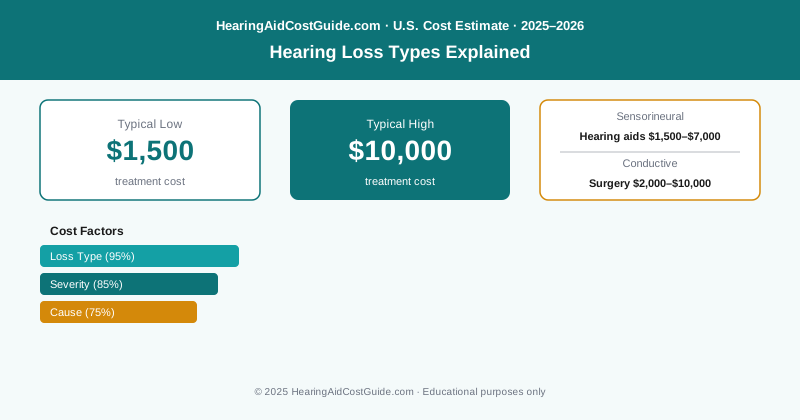
Two people can have the same degree of hearing loss on paper — and need completely different treatments. One needs hearing aids. The other needs a 45-minute surgical procedure and might never need a hearing aid at all.
That’s the difference type makes. Audiologists classify hearing loss by where it originates: the outer or middle ear, the inner ear, or both. The three categories — sensorineural, conductive, and mixed — aren’t just medical labels. They’re a roadmap to treatment. Get the type wrong and you’ve either spent thousands on a device that won’t help, or you’ve delayed a fixable problem for years.
Sensorineural Hearing Loss: The Most Common Type
Sensorineural hearing loss (SNHL) originates in the cochlea (inner ear) or auditory nerve. It accounts for roughly 90% of all hearing aid wearers and is what most people mean when they say “hearing loss.”
The cochlea contains about 15,000 hair cells that convert sound vibration into electrical signals. When those cells are damaged or die, they don’t regenerate — and the hearing loss is permanent. According to the NIDCD, 1 in 3 adults over 65 has age-related sensorineural hearing loss, and 26 million Americans between ages 20 and 69 already have measurable noise-induced cochlear damage.
Common causes:
- Aging (presbycusis) — gradual high-frequency hair cell loss, affects 1 in 3 adults over 65 (NIDCD)
- Noise exposure — 26 million Americans ages 20–69 have noise-induced hearing loss (NIDCD)
- Genetics — over 100 genes associated with hereditary hearing loss
- Ototoxic medications — certain chemotherapy drugs (cisplatin), high-dose aspirin, some antibiotics (aminoglycosides)
- Viral infections — mumps, measles, meningitis affecting the inner ear
The treatment reality: SNHL is permanent. Hearing aids amplify sound to compensate for reduced hair cell function. For severe to profound SNHL where hearing aids aren’t providing enough benefit, cochlear implants bypass the damaged hair cells entirely and stimulate the auditory nerve directly.
Over-the-counter (OTC) hearing aids — sold at pharmacies and online without a prescription — are FDA-approved only for mild to moderate sensorineural hearing loss in adults 18 and older. They do nothing for conductive hearing loss and are not appropriate for mixed or severe loss. An audiologist’s evaluation is the only way to know which type you have.
Conductive Hearing Loss: Often Treatable
Conductive hearing loss originates in the outer ear or middle ear — the mechanical pathway that delivers sound to the cochlea. Something is blocking or dampening vibration before it reaches the inner ear.
Because the cochlea and auditory nerve are intact, the hearing loss is often fully reversible — but the treatment is medical, not a hearing aid.
Common causes and their treatments:
Earwax (cerumen) blockage — the most common cause of sudden mild-to-moderate conductive loss. Removal by a clinician (or safely at home with drops) typically restores hearing fully. Cost: $50–$200 at a clinic.
Otitis media (ear infection/fluid) — fluid behind the eardrum, extremely common in children but also occurs in adults. Usually resolves on its own or with antibiotics. Chronic cases may need ear tubes (myringotomy), which allow fluid to drain.
Eardrum perforation — a hole in the eardrum from infection, trauma, or pressure. Small perforations often heal on their own. Larger ones may require tympanoplasty (surgical repair).
Otosclerosis — abnormal bone growth that fixes the stapes (smallest ossicle) in place, preventing it from vibrating. Caused by genetics and possibly viral factors. Treated with stapedectomy or stapedotomy — surgery to replace or bypass the fused stapes.
Cholesteatoma — a benign but destructive skin cyst in the middle ear that erodes bone. Requires surgery.
Mixed Hearing Loss
Mixed hearing loss has both sensorineural and conductive components. For example, someone might have age-related inner ear damage plus otosclerosis. Or a history of noise exposure plus chronic ear infections.
Treatment addresses both: the conductive component may be surgically corrected, and hearing aids address the remaining sensorineural component. Outcomes can be excellent — fixing even part of the problem often makes a significant difference in speech understanding.
Single-Sided Deafness
Single-sided deafness (SSD) — profound hearing loss or total deafness in one ear while the other ear is normal — is a distinct category with its own treatment options. Standard hearing aids don’t help because amplifying sound into a dead cochlea doesn’t work.
Options include:
- CROS hearing aids (Contralateral Routing of Signal) — a microphone on the deaf ear wirelessly transmits to a device on the hearing ear
- BiCROS aids — same concept, but the hearing ear also has hearing loss and uses amplification
- Bone-anchored hearing aids (BAHA) — a titanium implant in the skull behind the deaf ear conducts sound vibration through bone to the functioning cochlea on the other side
- Cochlear implant for SSD — increasingly offered and covered by some insurance when BAHA isn’t sufficient
| Type | Origin | Permanent? | Primary Treatment | Approximate Cost |
|---|---|---|---|---|
| Sensorineural | Cochlea / auditory nerve | Yes | Hearing aids | $1,500–$7,000/pair |
| Sensorineural (severe-profound) | Cochlea | Yes | Cochlear implant | $50,000–$100,000 (insured) |
| Earwax blockage | Ear canal | No | Removal | $50–$200 |
| Ear tubes (otitis media) | Middle ear fluid | No | Myringotomy | $2,000–$3,000 per ear |
| Tympanoplasty (perforated eardrum) | Middle ear | Usually no | Surgery | $4,000–$10,000 |
| Otosclerosis | Middle ear bones | No | Stapedectomy | $7,000–$10,000 |
| Mixed loss | Both | Partial | Combined approach | Varies |
| Single-sided deafness | Cochlea | Yes | CROS, BAHA, or CI | $2,500–$10,000+ |
Why the Distinction Matters So Much
Two people walk out of a hearing test with identical results — same degree of loss, same frequencies affected. One has SNHL from decades of noise exposure. The other has conductive loss from otosclerosis. Person one needs hearing aids. Person two might be fully cured by one outpatient procedure.
Or flip it: someone picks up OTC hearing aids because they assume it’s age-related loss. But they actually have conductive loss from earwax buildup. The aids don’t help. They conclude “hearing aids don’t work for me” — and they still have a completely fixable problem nobody addressed because nobody checked the type first.
At your evaluation, ask specifically:
- “What type of hearing loss do I have — sensorineural, conductive, or mixed?”
- “Is any part of my hearing loss medically or surgically treatable?”
- “Should I see an ENT before we discuss hearing aids?”
Audiologists are trained to identify all three types and to refer appropriately. If you’re told you need hearing aids without being told what type of loss you have, ask these questions directly.
Getting the Right Diagnosis
An audiologist’s diagnostic evaluation covers all three types. The standard battery includes:
- Pure tone audiogram — tests hearing at frequencies from 250–8,000 Hz
- Bone conduction testing — places a vibrator on the mastoid bone behind the ear to bypass the outer/middle ear and test the cochlea directly; comparing air and bone conduction results is how audiologists distinguish SNHL from conductive loss
- Tympanometry — tests middle ear pressure and eardrum mobility to detect fluid, perforations, or ossicle problems
- Speech audiometry — tests how well you understand speech, not just whether you can hear tones
Without insurance, a full diagnostic evaluation runs $100–$250. Many audiologists offer free screenings. Some ENT offices include the audiogram in the initial consultation fee.
The evaluation takes 45–60 minutes and gives you a direct answer about what type of loss you have, what’s causing it, and what the realistic treatment options are. That 45 minutes is the only honest foundation for any useful treatment decision. Skipping it — and going straight to hearing aids — is like treating a broken leg with a heating pad.