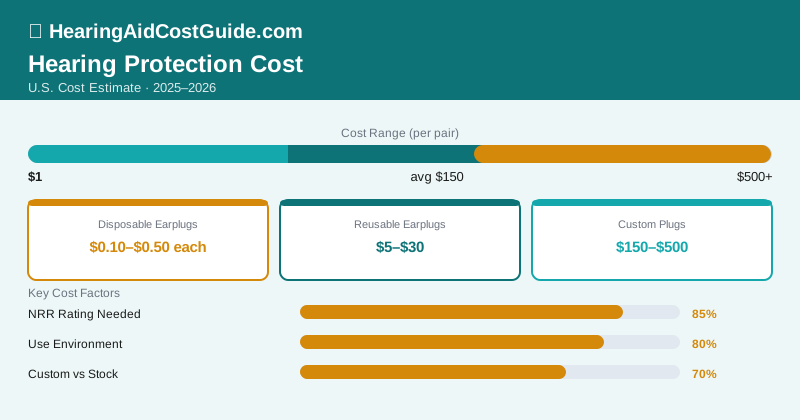
Here’s the math that should make you stop and read this: a pair of foam earplugs costs about 25 cents and protects your hearing from permanent damage. A pair of prescription hearing aids to treat the noise-induced hearing loss you get from skipping that 25-cent step runs $3,000–$7,000 and needs replacing every 5–7 years. The NIDCD estimates noise-induced hearing loss affects roughly 17% of adults in the US. Almost all of it is preventable.
Here’s what actually works, what the ratings mean, and what you should spend.
Understanding NRR: What the Numbers Mean
Every hearing protection device sold in the US carries an NRR — Noise Reduction Rating — from the EPA. Higher is more protection. But the number on the box isn’t what you’ll actually get in the field.
OSHA’s practical formula: (NRR – 7) ÷ 2 = approximate dB reduction in real use. An earplug rated NRR 33 gives you roughly 13 dB of real-world protection when worn correctly. Fit matters enormously — a foam plug jammed in halfway gives you a fraction of its rated protection.
The American Academy of Audiology recommends hearing protection whenever you’re exposed to sounds above 85 dB. For reference: a lawnmower runs about 90 dB, a motorcycle 95 dB, a rock concert 100–110 dB, and gunfire 140–165 dB.
The Full Range of Options
Disposable Foam Earplugs
The workhorse of hearing protection. Roll them down, insert, and let them expand in the canal. Properly fitted, they’re among the most effective options available — NRR 29–33 is common. Most people underfit them, which is why they seem like they don’t work.
- Cost: $0.10–$0.50 each; sold in boxes of 50–200 pairs
- Best for: Workplace noise, mowing, power tools, one-time events
- Limitation: Muffles everything including speech — not ideal when situational awareness matters
| Protection Type | Typical Cost | NRR Range | Best Use Case |
|---|---|---|---|
| Disposable foam earplugs | $0.10–$0.50/pair | 29–33 | Workplace, power tools |
| Reusable silicone earplugs | $5–$30 | 22–28 | Reuse, moderate noise |
| Over-ear earmuffs (basic) | $15–$40 | 22–29 | Yard work, shooting |
| Over-ear earmuffs (premium) | $40–$80 | 27–31 | Industrial, extended wear |
| Custom-molded earplugs | $150–$350 | 20–35 | Workplace, general use |
| Custom musician earplugs | $150–$500 | 9–25 (flat) | Musicians, concerts |
| Custom shooting/hunting earplugs | $200–$500 | High + electronic | Hunting, firearms |
| Electronic earmuffs (shooting) | $50–$250 | 22–30 | Shooting where awareness needed |
Reusable Earplugs
Pre-formed silicone or rubber plugs that insert without rolling. Less effective than properly fitted foam — NRR 22–28 typically — but washable, long-lasting, and more comfortable for all-day wear. Many users prefer them for yard work or extended shifts.
- Cost: $5–$30 per pair
- Popular brands: Mack’s, Eargasm, 3M E-A-R
Earmuffs
Earmuffs fit over the entire outer ear and seal against the head. There’s no insertion technique to get wrong — that’s their main advantage. Good option for workers who move in and out of noisy areas repeatedly throughout the day.
- Basic models (Howard Leight, 3M Peltor): $15–$40
- Premium models with communication features: $40–$80
- Electronic earmuffs (amplify speech, suppress gunshots): $50–$250
Electronic earmuffs are popular among hunters and at shooting ranges. They let you hear a normal conversation, then clamp down automatically when a shot fires. Decent ones start around $100.
In very high noise environments above 100 dB, hearing protection professionals recommend combining earplugs and earmuffs. This doesn’t double the protection, but adds roughly 5 dB of additional attenuation. OSHA’s guidance for combined use: take the higher NRR device’s value and add 5 dB. Firearms ranges and industrial settings often require this approach.
Custom-Molded Earplugs
Custom earplugs are made from an impression of your ear canal taken by an audiologist or hearing instrument specialist. They fit perfectly every time — no technique, no guessing. Consistent fit means consistent protection.
- Standard custom earplugs: $150–$350 per pair
- Custom musician earplugs with flat-attenuation filters: $150–$500
- Custom shooting/hunting plugs: $200–$500
- Lifespan: 3–5 years with proper care
Custom musician earplugs deserve special mention. Unlike foam plugs that muffle everything uniformly, musician plugs use a precision acoustic filter to reduce all frequencies evenly — music sounds like music, just at a lower volume. Common filter strengths: 9 dB, 15 dB, or 25 dB. For anyone who attends concerts regularly, works in music venues, or plays in a band, these are a genuinely superior product.
Employer Obligations Under OSHA
OSHA’s Hearing Conservation Standard (29 CFR 1910.95) requires employers to:
- Monitor noise and identify workers exposed to 85+ dB averaged over an 8-hour shift
- Provide hearing protection at no cost to those employees
- Train employees on proper use
- Provide annual hearing tests for exposed workers — at no cost
If you work in a loud environment and your employer hasn’t provided hearing protection or testing, that’s an OSHA violation. The cost falls on the employer, not you.
The long-term math is pretty clear. Custom musician earplugs cost $200–$500 and last 5 years — roughly $40–$100 per year. The prescription hearing aids that result from skipping that protection cost $3,000–$7,000 per pair and need replacing every 5–7 years — roughly $430–$1,400 per year, indefinitely. Prevention wins financially, and the hearing you protect is irreplaceable. See our full hearing aid cost guide for what treatment actually runs.
Bottom Line
Disposable foam earplugs at $0.10–$0.50 each provide outstanding protection when worn correctly and handle most workplace and recreational noise situations. Custom earplugs ($150–$500) earn their cost for musicians and regular shooters who need consistent fit and specific attenuation. Earmuffs ($15–$80) are the easiest to use correctly and the best fit for intermittent noise. Whatever you choose — use it. Noise-induced hearing loss accumulates quietly over years, and by the time you notice it, the damage is done.