Q: Can I use my HSA or FSA to buy hearing aids?
A: Yes — and you absolutely should.
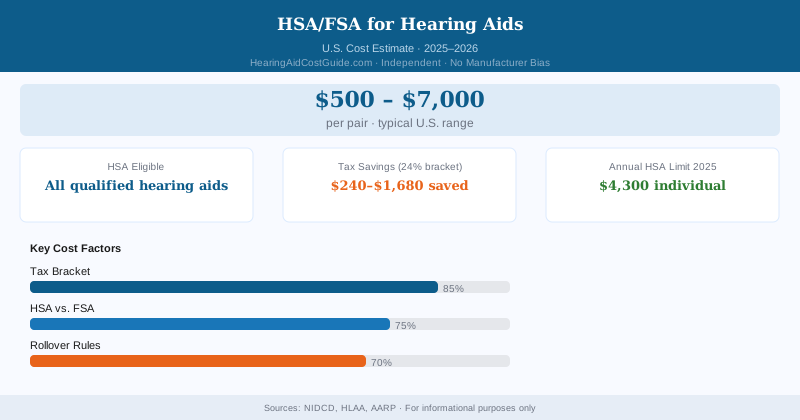
HSAs and FSAs are the most underused cost-reduction tools in hearing healthcare. They let you pay with pre-tax dollars, which effectively cuts your hearing aid cost by your marginal tax rate — typically 22–32% for most working adults. On a $4,000 purchase, that’s $880–$1,280 in real savings before you’ve done anything else.
Here’s what’s covered, how the two accounts differ, and how to use them without triggering an IRS headache.
What Hearing Expenses Are HSA/FSA Eligible?
| Expense | HSA Eligible | FSA Eligible |
|---|---|---|
| Prescription hearing aids | Yes | Yes |
| OTC hearing aids | Yes (CARES Act 2020) | Yes (CARES Act 2020) |
| Hearing aid batteries | Yes | Yes |
| Audiological evaluations | Yes | Yes |
| Hearing aid fittings | Yes | Yes |
| Hearing aid repairs | Yes | Yes |
| Hearing aid accessories (streamers, etc.) | Yes | Yes |
| Tinnitus treatment programs | Yes | Yes |
| Cochlear implant and surgery | Yes | Yes |
| BAHA device and surgery | Yes | Yes |
| Personal Sound Amplifiers (PSAPs) | No | No |
Q: What changed with the CARES Act in 2020?
Before 2020, HSA and FSA funds could only cover prescription hearing aids. The CARES Act expanded eligibility to include OTC medical devices — including OTC hearing aids from Jabra, Sony, Eargo, and Lexie. That’s a significant win for OTC buyers who previously had to pay out of pocket.
One important distinction: the product must be FDA-registered as a hearing aid. PSAPs (personal sound amplification products) that aren’t registered as FDA hearing aids are still ineligible — even if they look identical to an OTC hearing aid at the same price point. Check the product’s FDA status before purchasing.
Q: What’s the difference between an HSA and an FSA?
Health Savings Account (HSA):
- Only available with a qualifying High Deductible Health Plan (HDHP)
- 2025 contribution limits: $4,300 (individual) / $8,550 (family) / +$1,000 if age 55+
- Funds roll over indefinitely — no “use it or lose it” pressure
- Triple tax advantage: contributions pre-tax, growth tax-free, withdrawals tax-free for medical expenses
- Can invest surplus funds for long-term growth
- Best for planning a future hearing aid purchase while building a balance
Flexible Spending Account (FSA):
- Available with most employer-sponsored health plans
- 2025 contribution limit: $3,200/employee
- “Use it or lose it” — most FSA funds don’t roll over (limited grace period or carryover allowed)
- Same tax advantage for qualified medical expenses
- Best when you know you’re buying hearing aids this plan year
Working adult, 24% marginal tax rate, needs hearing aids at $5,000/pair:
- Max out HSA: $4,300 contributed pre-tax = $1,032 in federal tax savings alone
- Pay $4,300 of the hearing aids with HSA (saving $1,032 in taxes)
- Pay remaining $700 out of pocket
- Total effective cost of $5,000 hearing aids: $3,968 ($1,032 saved)
State tax savings are additional. At 5% state income tax, add another $215 in savings.
Q: How do I actually pay with HSA/FSA funds?
At an audiology clinic or Costco: Tell the front desk you’re paying with your HSA/FSA debit card. Swipe it directly at checkout. If the card is declined for a non-medical reason, pay out of pocket and submit for reimbursement — it’s the same tax benefit either way.
For OTC hearing aids online: Major retailers (Amazon, Best Buy, CVS, Walgreens) accept HSA/FSA debit cards for eligible products. If a transaction is declined, verify the specific product is marked as FSA/HSA eligible in the retailer’s system — some OTC products aren’t properly coded.
For audiologist services: Evaluations, fittings, and follow-up programming are all eligible. Pay at the clinic with your card or submit receipts for reimbursement.
Q: What documentation do I need to keep?
The IRS requires documentation for HSA withdrawals. Keep all receipts and invoices — an itemized receipt showing “hearing aids” or “audiological evaluation” is sufficient. An Explanation of Benefits (EOB) from your insurance also works.
You don’t need a prescription to buy OTC hearing aids with HSA/FSA funds (a 2023 IRS clarification made this explicit). The device’s OTC medical status alone qualifies it.
Personal Sound Amplification Products (PSAPs) are NOT eligible for HSA/FSA reimbursement, even after the CARES Act. The device must be FDA-registered as an OTC hearing aid — not just an amplifier. Check the product’s FDA status before purchasing with HSA/FSA funds, especially for lower-priced amplification devices that may not meet the FDA hearing aid standard.
Q: What about Dependent Care FSA — is that the same thing?
No — and mixing them up is a common, costly mistake. The Health FSA (medical) is what covers hearing aids and audiology expenses. The Dependent Care FSA covers childcare costs only. They’re separate accounts even when administered by the same company. Make sure you’re drawing from the right one before submitting for reimbursement.
Q: Can I use my HSA in retirement?
Absolutely — and HSAs become even more valuable after 65. At that age, you can withdraw HSA funds for non-medical expenses without penalty (though income tax applies, similar to a traditional IRA). For medical expenses including hearing aids, HSA withdrawals remain completely tax-free at any age. Since traditional Medicare doesn’t cover hearing aids, the HSA becomes one of the few tax-advantaged ways to fund hearing care in retirement.