42% of adults who need hearing aids delay getting them because of stigma, according to the NIDCD. The IIC — invisible-in-canal — was designed specifically for people in that 42%.
It sits so deep in the ear canal that it’s essentially invisible to anyone looking at you straight on. No visible dome. No external tube. No behind-the-ear unit. Just a tiny shell custom-molded to your specific ear canal shape, fitted by an audiologist.
The trade-off? You’ll pay more than for almost any other hearing aid style — and not every person qualifies for one.
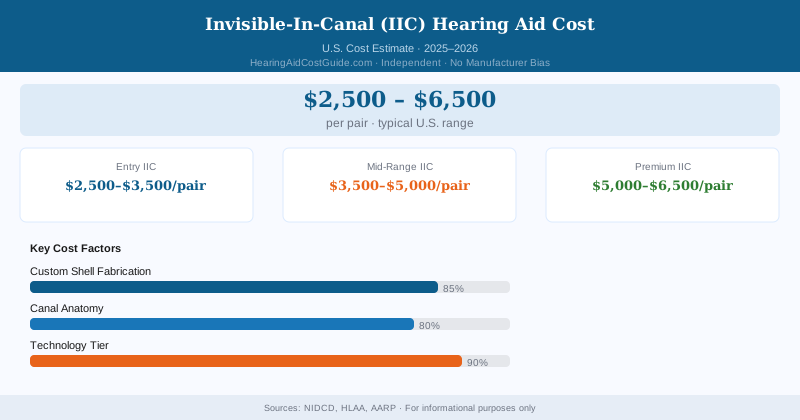
IIC Hearing Aid Cost Overview
| Tier | Cost Per Pair | Examples |
|---|---|---|
| Entry IIC (basic features) | $2,500–$3,500 | Signia Silk X, Starkey Evolv AI CIC |
| Mid-range IIC | $3,500–$5,000 | Phonak Virto M Titanium, Oticon Own |
| Premium IIC | $5,000–$6,500 | Starkey Genesis AI IIC, Widex Moment Sheer |
| Costco IIC equivalent | $1,800–$2,800 | Kirkland KS10 CIC (closest available) |
Prices shown are per pair (two aids). Single-ear pricing runs roughly 55–60% of per-pair cost.
Why IIC Aids Cost More Than Other Styles
It’s not just marketing. There are real engineering reasons why invisible-in-canal aids land at the top of the price range.
Custom shell fabrication. Every IIC is made from a digital scan or physical impression of your specific ear canal. There’s no “small, medium, large” sizing. The shell is 3D-printed or hand-crafted to fit you and only you. That custom manufacturing adds $200–$500 to production cost compared to a standard RIC aid.
Miniaturized components. Packing a microphone, receiver, processor chip, and battery into something smaller than a pea requires the smallest available components — and those components cost more per unit.
Phonak Virto Titanium. Phonak’s titanium-shell IIC is a good example of premium materials driving cost. The titanium shell is 15 times stronger than acrylic, allowing thinner walls and better fit in very narrow canals — but titanium manufacturing isn’t cheap.
Limited OTC options. Most OTC hearing aids are RIC (receiver-in-canal) or BTE (behind-the-ear) styles. IIC aids almost universally require an audiologist impression and custom fabrication, which means you’re in the prescription-only market with its higher price structure.
Who Qualifies for an IIC?
Not everyone can wear an IIC. Your audiologist will determine candidacy based on:
- Ear canal size and shape. Very small or curved canals may not accommodate an IIC shell safely.
- Degree of hearing loss. IICs work best for mild-to-moderately-severe loss. Profound loss typically requires more power than these tiny devices can deliver.
- Dexterity. IICs have no external controls — you insert and remove a tiny device using a removal cord. If arthritis or fine motor issues are a concern, an IIC may be impractical day-to-day.
- Ear wax production. Positioned deep in the canal, IICs are vulnerable to moisture and wax. High wax producers often have shorter device lifespans and higher repair frequency.
Before committing to an IIC, ask your audiologist two questions: “Does my canal anatomy support a deep-fit device?” and “What’s the expected wax-related maintenance cost for my ear type?” Those answers will tell you a lot about whether IIC is right for your specific situation.
IIC vs. CIC vs. ITC: What’s the Difference?
People often confuse these three custom styles. Here’s a quick breakdown:
- IIC (Invisible-In-Canal): Deepest fit, sits in the second bend of the canal. Invisible in most ear types.
- CIC (Completely-In-Canal): Sits slightly less deep. Tiny faceplate may be visible at the canal opening. Usually less expensive by $300–$700.
- ITC (In-The-Canal): Sits at the canal opening. More visible but easier to handle, has room for volume controls.
If invisibility is your top priority, IIC is the answer. If you want something discreet but more manageable, CIC is a strong alternative.
What Features Do You Give Up with IIC?
The miniaturization required for IIC form factor means some features can’t fit. Specifically:
- No directional microphones on most models (some premium IICs have dual-mic arrays, but space is limited)
- No telecoil (T-coil) — no loop system compatibility
- No Bluetooth streaming on most models (Phonak Virto Paradise IIC is a notable exception with Roger and some Bluetooth)
- Shorter battery life — most IICs use size 10 batteries lasting 3–7 days, or limited rechargeable options
- No manual controls on many models — volume/program changes via companion app only
For users who want to stream audio directly from their phone, a RIC or BTE style may serve them better despite being more visible.
Lifespan and Ongoing Costs
ASHA (American Speech-Language-Hearing Association) estimates the average hearing aid lifespan at 3–7 years. For IICs, real-world lifespan often runs 3–5 years due to moisture and wax exposure in the deep canal position.
Ongoing costs to budget:
- Cleaning and maintenance: $75–$150/year at an audiologist office
- Repair: $150–$400 per incident (common: receiver failure, shell crack)
- Replacement: $1,250–$3,250 per ear every 3–5 years
- Size 10 batteries: $35–$60/year (if not rechargeable)
Factor these into your total cost-of-ownership calculation. A $5,000 pair that lasts 4 years with $200/year in maintenance costs $5,800 total — roughly the same as a $4,000 RIC pair with longer lifespan and lower maintenance.
Some audiologists offer a “trial period” of 30–60 days on custom IIC aids. Unlike standard RIC aids that can be returned easily, custom-molded IICs may carry a restocking fee of $250–$500 if returned, because the shell was fabricated specifically for you. Confirm the return policy in writing before signing.
Insurance and FSA/HSA Coverage
IIC aids are covered under the same rules as other prescription hearing aids. Most private insurance plans offer $1,000–$2,500 per ear (per benefit period), regardless of style. Medicare Advantage hearing benefits typically apply to IIC models the same as other custom aids.
If you have an HSA or FSA, IIC aids are a qualified expense. A $5,000 pair purchased with pre-tax FSA funds effectively costs $3,500–$4,000 depending on your tax bracket — a meaningful discount.
The bottom line: IIC aids are the most discreet technology available in hearing care, and they work very well for the right candidate. They’re not the right fit for everyone — literally or figuratively. But if you qualify and invisibility is a real priority for you, the technology is genuinely impressive and the pricing has become more accessible in recent years.