Most people assume that getting free hearing aids means months of paperwork, income verification committees, and waiting lists that stretch into the next year. Lions Clubs International doesn’t work that way — and that surprises a lot of people.
Lions has been committed to hearing and vision services since 1925, when founder Melvin Jones challenged members to serve those with sight impairments. A century later, hearing health is one of Lions’ three core global causes, and roughly 6,000 US chapters are out there doing the work. Many offer reconditioned hearing aids, free screenings, and audiologist referrals — all with minimal bureaucracy.
What Lions Clubs Offer for Hearing
| Service | Availability | Cost |
|---|---|---|
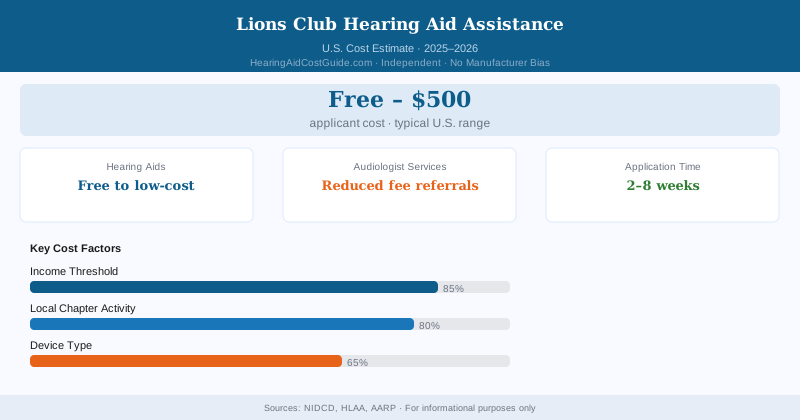
| Used/reconditioned hearing aids | Most US chapters | Free or $0–$50 processing |
| New hearing aids (select programs) | Varies by region | Free (via Starkey/manufacturer partnerships) |
| Hearing screenings | Regular community events | Free |
| Audiologist referrals | Many chapters | Free referral, cost of care varies |
| Batteries (some chapters) | Select chapters | Free or donated |
How the Lions Club Hearing Aid Program Works
The mechanics are simpler than people expect. Community members donate old hearing aids. Local Lions chapters collect them and ship them to regional processing centers where they’re cleaned, tested, and reconditioned. Then they go back out — to local recipients and to international partners serving people with even fewer resources.
Some chapters skip the reconditioned route entirely and partner directly with Starkey Hearing Foundation or other manufacturers to distribute brand-new devices. Whether you get a refurbished aid from three years ago or a new one depends entirely on your local chapter.
A fair warning: older analog devices provide real benefit to someone who currently has nothing, but they won’t compete with what modern digital hearing aids do in noise or speech clarity. Think of a Lions-provided reconditioned aid as a meaningful starting point, not necessarily the permanent solution.
How to Apply for Lions Club Hearing Aids
There’s no central application portal or national waiting list. Each chapter runs its own program — which means the process varies, but it’s also faster than government programs.
Step 1: Find your nearest Lions Club. Use the club locator at lionsclubs.org. With 6,000 US chapters, there’s likely one within reasonable distance.
Step 2: Call or email directly. Don’t overthink the approach. Just say: “I’m looking for hearing aid assistance and wanted to ask if your chapter offers this and how I’d apply.” You’ll know within minutes whether this chapter can help.
Step 3: Gather what they ask for. Most chapters want a recent audiogram and some form of financial hardship documentation — though some skip the paperwork entirely for clearly urgent cases.
Step 4: Fitting. If a device is available, the chapter typically arranges fitting through a volunteer audiologist or a partner hearing clinic. Larger urban chapters often have dedicated audiology partnerships that make the process smoother.
Lions Clubs are locally governed, and not every chapter has an active hearing aid program. Rural or small chapters may focus on different service areas. If your nearest chapter doesn’t offer hearing aid assistance:
- Contact adjacent chapters — the regional Lions District may have a centralized hearing program
- Ask the chapter about referrals to Sertoma International or Starkey Foundation events
- Contact the Lions District office for your region — they often coordinate regional hearing programs
Lions Club Hearing Events
Several times a year, Lions Districts host community health events at churches, fairgrounds, or community centers. These single-day events can screen and serve dozens or hundreds of people — free hearing tests, same-day hearing aids for eligible recipients, and referrals for follow-up care.
To find upcoming events, your best bets are:
- Call your local chapter and ask directly about upcoming health fairs
- Check in with your regional HLAA chapter — they tend to track Lions events
- Monitor community event boards and local Facebook groups for Lions health days
The Reality of Reconditioned Hearing Aids
Reconditioned doesn’t mean broken, but it doesn’t mean cutting-edge either. Here’s what you should realistically expect:
What you’ll likely get: Basic amplification that’s been cleaned and tested. Often includes batteries, a carrying case, and cleaning tools. The device was probably donated because someone upgraded — so it’s in working condition.
What you probably won’t get: Bluetooth streaming, smartphone app control, rechargeable batteries, advanced noise cancellation, or programming precisely matched to your specific audiogram. Digital aids from five years ago work, but they’re not 2025 devices.
For someone with financial hardship and a moderate hearing loss, this is a real solution. For someone with severe or complex loss who needs precise audiogram-matched fitting, the Lions device is a bridge — not the destination.
Donating Hearing Aids to Lions
Got old hearing aids gathering dust in a drawer? Lions chapters accept them in any condition. Even non-functional devices can sometimes be repaired or cannibalized for parts. Call your nearest chapter to coordinate, or ask your audiologist — many serve as informal drop-off points for Lions donations.
Even with donated Lions Club hearing aids, getting a current audiogram from a participating audiologist is important. Without a recent audiogram, it’s difficult to confirm that the donated device is appropriate for your specific hearing loss profile, or to properly program digital devices to your hearing needs. Ask your local HLAA chapter or community health center about low-cost or free hearing testing options before or alongside the Lions aid application.
Other Service Organizations With Hearing Programs
- Sertoma International (sertoma.org): Probably the most hearing-focused of all service organizations. Local chapters in many US communities actively run hearing health programs.
- Rotary International: Some Rotary clubs fund hearing health initiatives — worth a call if Lions comes up short.
- Kiwanis International: Primarily focused on children; some chapters fund pediatric hearing services.
None of these organizations advertise loudly. You have to seek them out. But the network is there — and in most US communities, at least one of these organizations has resources to help someone who genuinely can’t afford hearing aids through commercial channels.