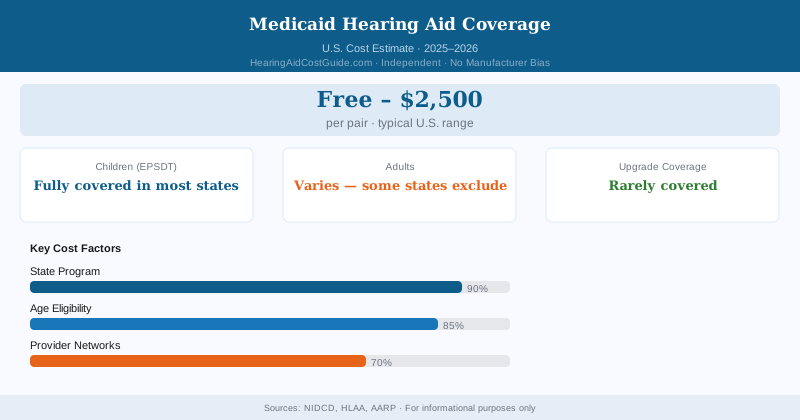
Here’s something most Medicaid enrollees don’t know: if you’re under 21, your state must cover hearing aids — no exceptions, no loopholes, no waiting for state budget cycles to cooperate. For adults, though, it’s an entirely different story. Coverage swings from robust to zero depending on which state issued your Medicaid card.
That patchwork matters. Adults in California or Minnesota can walk into an audiology clinic and get hearing aids covered by Medicaid. Adults in Texas or Georgia may not have that option at all under traditional Medicaid.
Medicaid Hearing Aid Coverage for Children: Universal
The federal EPSDT (Early and Periodic Screening, Diagnostic, and Treatment) mandate is one of the strongest in all of health policy: every state Medicaid program must cover hearing aids for children under 21 when medically necessary. CMS enforces this, and states don’t get to opt out.
What EPSDT coverage typically includes:
- Full audiological evaluation
- Prescription hearing aids for both ears when indicated
- Earmolds and replacement components
- Ongoing audiological monitoring and reprogramming as the child grows
- Cochlear implant candidacy evaluation and devices when appropriate
Children’s Medicaid hearing coverage is generally strong in practice. The real challenge is finding audiologists who accept Medicaid — call your state Medicaid office or CHIP program for a current provider list, since directories go stale fast.
Medicaid Hearing Aid Coverage for Adults by State
| Coverage Level | States (approximate 2025) | Typical Benefit |
|---|---|---|
| Comprehensive adult coverage | ~15 states | Both aids, no or minimal limit |
| Limited adult coverage | ~15 states | One aid, or dollar cap $500–$1,500 |
| No adult coverage | ~20 states | $0 |
States with generally comprehensive adult hearing coverage: California, New York, Pennsylvania, Massachusetts, Washington, Oregon, Colorado, Minnesota, Wisconsin, Michigan, and others. These states cover both ears and typically don’t impose severely restrictive dollar caps.
States with limited or no adult hearing coverage: Many Southern states — Florida, Texas, Georgia, Alabama, Mississippi — have historically restricted or eliminated adult hearing aid benefits. This isn’t permanent; coverage changes year to year with state legislative sessions.
How to Check Your State’s Medicaid Hearing Benefit
Don’t guess. Coverage changes frequently, and a call takes five minutes:
- Call Medicaid member services (number on your card) and ask: “Does my Medicaid plan cover hearing aids for adults? What’s the coverage limit?”
- Check your state Medicaid website — search “[your state] Medicaid hearing aid coverage”
- Ask your audiologist’s billing staff — they deal with this daily and usually know
- HLAA resource list: The Hearing Loss Association of America maintains a state-by-state benefit summary worth bookmarking
Most states now deliver Medicaid through managed care organizations (MCOs) — private insurers that contract with the state. Your benefits depend on both state Medicaid rules AND your specific managed care plan. The same state’s two different MCO plans may have different hearing aid benefits. Know your specific MCO plan, not just your state’s baseline.
Medicaid Hearing Aid Process: Step by Step
Step 1: Get an audiological evaluation. Find an audiologist who accepts your Medicaid plan. Hospital audiology departments reliably accept Medicaid. Your state Medicaid website has enrolled provider lists — call first to confirm they’re currently accepting new Medicaid patients.
Step 2: Document medical necessity. The audiologist submits your audiogram and clinical notes supporting the hearing aid request. The language matters — “medically necessary” framing is what Medicaid reviewers look for.
Step 3: Prior authorization. For adult hearing aids, prior authorization is almost always required — a formal approval request submitted before the devices are ordered. Your audiologist handles the paperwork. Budget 2–4 weeks.
Step 4: Device selection. Medicaid plans work from an approved device list or a per-device dollar cap. You pick from what’s in range.
Step 5: Fitting and follow-up. Professional fitting is covered as part of the hearing aid benefit. Follow-up visits are covered as audiological services.
CHIP (Children’s Health Insurance Program)
CHIP serves children in families who earn too much for Medicaid but can’t afford private insurance. Like Medicaid’s EPSDT requirements, CHIP must cover hearing aids for children when medically necessary. See our full CHIP hearing coverage guide for more detail.
Common Medicaid Hearing Aid Restrictions
Even where adult coverage exists, it usually comes with limits:
- Frequency limits: One device per ear every 3–5 years
- Dollar caps: Coverage only up to $500–$1,500 per aid
- Device tier restrictions: Entry-level or specific approved models only
- Single ear coverage: Some states cover only one aid even with bilateral loss
- Age restrictions: A handful of states impose upper age limits on adult hearing benefits
Never assume your Medicaid plan doesn’t cover hearing aids without calling to confirm. Coverage changes frequently as states adjust their programs. A coverage exclusion that applied two years ago may have been restored. Always verify current year benefits before paying out of pocket.
Dual-Eligible: Medicare + Medicaid
Adults who qualify for both Medicare and Medicaid — called “dual-eligibles” — can sometimes layer benefits from both programs. Traditional Medicare covers zero hearing aids, but Medicaid may step in where Medicare leaves off. Medicare Savings Programs can also cover Medicare premiums for low-income seniors, freeing up income for other health expenses. If you’re dual-eligible, a benefits counselor or social worker can map out exactly what’s available to you from both sides.