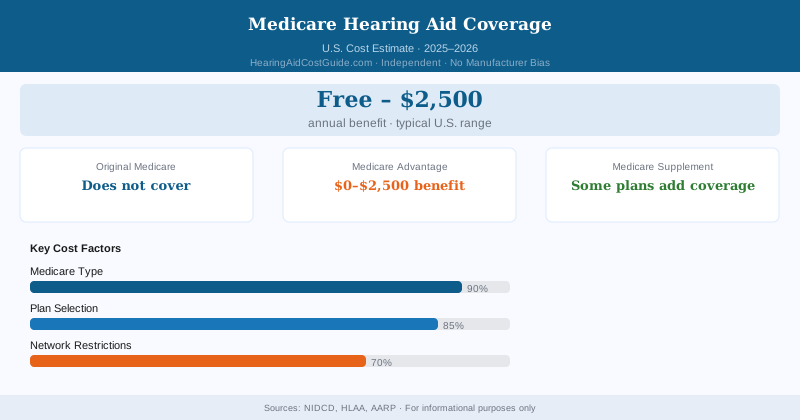
A retired teacher in Ohio — we’ll call her Ruth — spent forty years contributing to Medicare payroll taxes. She turned 65, enrolled in original Medicare, and went to her audiologist to address the hearing loss that had been building for years. The audiologist quoted her $5,800 for a pair of prescription hearing aids. Medicare’s contribution: $0.
Ruth’s story isn’t unusual. It plays out millions of times a year, and it’s one of the most misunderstood gaps in the American healthcare system. Here’s exactly what Medicare covers — and where the real opportunities are.
Medicare Coverage by Plan Type
| Medicare Type | Covers Hearing Aids? | Covers Hearing Tests? |
|---|---|---|
| Part A (hospital) | No | Only inpatient diagnostic |
| Part B (medical) | No | Yes — when medically necessary |
| Original Medicare (A+B) | No | Limited diagnostic only |
| Medicare Advantage (Part C) | Often yes | Yes (as exam benefit) |
| Part D (prescription drugs) | No | N/A |
| Medicare Supplement (Medigap) | No | No |
Original Medicare (Parts A and B): The Hard Truth
Section 1862(a)(7) of the Social Security Act explicitly excludes hearing aids from Medicare coverage. This is a statutory exclusion — not a regulatory policy that CMS can waive — which means only an act of Congress can change it.
What Part B does cover for hearing:
- Diagnostic audiology services: Hearing tests ordered by a physician to investigate a specific medical symptom, billed under CPT 92557. Covered at 80% after the $240 Part B deductible (2025).
- Balance testing: Vestibular testing ordered for medical reasons
- Cochlear implants: Device and surgery, covered as a prosthetic
- BAHA systems: Bone-anchored hearing aids, covered as prosthetic devices
Not covered by original Medicare:
- Routine hearing screenings
- Hearing aids of any kind
- Audiological rehabilitation
- Hearing aid fitting and programming
- OTC hearing aids
Medicare Advantage: Where the Opportunity Is
Medicare Advantage (Part C) plans are private insurance plans approved by Medicare. They must cover everything original Medicare covers — and they can layer on extra benefits. Hearing aids are the most common supplemental benefit they add.
According to KFF (2024), 76% of Medicare Advantage enrollees are in plans that include a hearing benefit. That’s meaningful coverage in a market where original Medicare covers zero.
Common Medicare Advantage Hearing Benefits
AARP UnitedHealthcare Plans:
- Annual routine hearing exam covered
- Hearing aid allowance: $500–$2,000 per ear ($1,000–$4,000 per pair)
- Network providers through UnitedHealthcare Hearing (TruHearing network)
- OTC hearing aids covered at select plans
Humana:
- Hearing exam coverage varies by plan
- Aid allowance: $500–$1,500 per pair (varies by plan)
- Some Humana HMO plans cover aids through HearUSA network
Aetna:
- AARP/Aetna Medicare Advantage: Routine hearing exam + aid allowance through TruHearing
- $0–$2,000 in aid allowances depending on specific plan
Anthem/BCBS:
- Varies significantly by state and plan type
- Some plans include $500–$1,000 per year hearing aid credit
Many Medicare Advantage plans deliver their hearing benefit through TruHearing, a national network of audiologists and hearing centers. Through TruHearing:
- You pay a set copay per device ($0–$699 per aid, depending on tier)
- Devices are typically Signia, ReSound, Phonak, or Oticon mid-tier models
- Three follow-up visits are included
- 1-year supply of batteries included
This is genuine value if the copay is low — but TruHearing devices are often mid-tier technology, and you’re restricted to network providers.
Maximizing Your Medicare Advantage Hearing Benefit
- Stay in-network: Out-of-network devices often aren’t covered at all
- Check what device tier is covered: Some benefits only apply to entry-level devices
- Ask about OTC coverage: Some 2025 MA plans cover OTC hearing aids at reduced or zero copay
- Use the benefit before December 31: Most hearing benefits don’t roll over to the next year
- Shop benefit levels at enrollment: Hearing coverage varies enormously between MA plans in the same market
Medicare Advantage Annual Enrollment Period
You can enroll in or switch Medicare Advantage plans during:
- Annual Enrollment Period (AEP): October 15 – December 7 each year
- Medicare Advantage Open Enrollment: January 1 – March 31 (switch or drop MA)
- Special Enrollment Periods: Based on life events like moving or losing other coverage
If your current plan has a weak hearing benefit — say, $500 per pair every three years — switching to a plan with stronger coverage at the next AEP is a real and financially significant option. Don’t assume you’re stuck.
Medigap (Medicare Supplement) and Hearing
Medigap covers gaps in original Medicare: deductibles, coinsurance, excess charges. Since original Medicare covers $0 of hearing aids, Medigap has nothing to supplement. No Medigap plan covers hearing aids — none, regardless of plan letter.
Beware of Medicare plans that advertise “hearing benefits” prominently. Read the plan’s Evidence of Coverage (EOC) document for the exact benefit amount, network restrictions, and covered device tiers. A plan that advertises “hearing aid coverage” might pay only $500/pair one time every three years — significant but not comprehensive. Know exactly what you’re getting before enrolling.
The Proposed HEAR Act and Future Medicare Coverage
Multiple bills have been introduced to add hearing, vision, and dental benefits to original Medicare, including the HEAR (Hearing Enhancement and Auditory Rehabilitation) Act. As of early 2025, no hearing aid benefit has been enacted. Advocacy organizations including HLAA and AARP continue to lobby for this change — support their efforts at hearitnow.org.
Ruth, the retired teacher from Ohio, eventually found a Medicare Advantage plan with a $1,500 hearing benefit. It didn’t cover her full cost, but it cut her out-of-pocket in half. That’s the kind of planning that makes a difference — and it starts with understanding exactly which type of Medicare you have.
Frequently Asked Questions
A pair of prescription hearing aids typically ranges from $4,000 to $6,500, depending on the brand, technology level, and features. Basic models start around $3,000 per pair, while premium devices with advanced noise cancellation can exceed $7,000.
No, Original Medicare (Part A and Part B) does not cover hearing aids or hearing aid fittings, leaving beneficiaries responsible for 100% of the cost. However, some Medicare Advantage (Part C) plans offer $500 to $2,000 in annual hearing aid benefits, so coverage varies by plan and carrier.
The typical timeline is 2–4 weeks from your initial audiologist appointment to receiving your fitted devices. This includes your hearing test, device selection, ordering, and 1–2 follow-up visits for adjustments and programming to match your hearing needs.