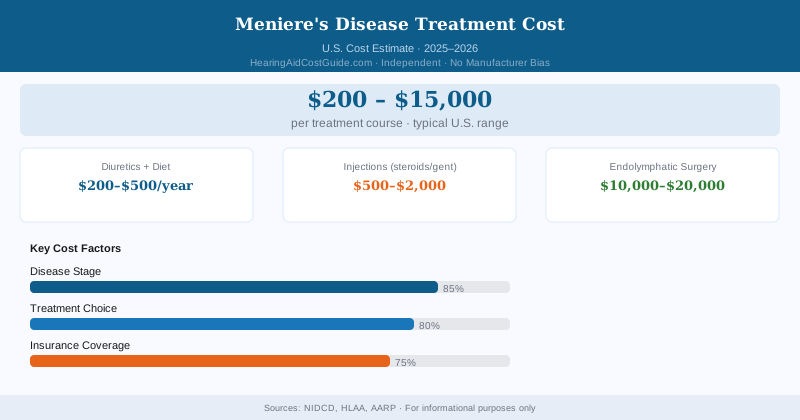
615,000 Americans are living with Menière’s disease right now. Most of them spent months — sometimes years — being told their vertigo and hearing loss were anxiety, migraines, or “just stress” before getting the correct diagnosis. Then they discover that treating it is its own journey: a layered, stepwise process that starts at nearly zero cost and can escalate to $30,000 surgery.
Here’s what each treatment stage actually costs, and when doctors move from one to the next.
Menière’s Disease Treatment Cost Overview
| Treatment | Cost | Evidence Level |
|---|---|---|
| Dietary management (low-sodium) | $0 | Moderate |
| Diuretics (HCTZ + triamterene) | $15–$40/month | Moderate |
| Betahistine (not FDA-approved in US) | $30–$80/month | Moderate (used in Europe) |
| Intratympanic dexamethasone (steroid) | $200–$600/injection | Good for vertigo |
| Intratympanic gentamicin (ablative) | $500–$1,500/injection | Very good; hearing risk |
| Endolymphatic sac surgery | $8,000–$20,000 | Moderate |
| Vestibular nerve section | $15,000–$30,000 | Excellent for vertigo; hearing risk |
| Labyrinthectomy | $10,000–$25,000 | Excellent; destroys hearing |
| Hearing aids (for associated HL) | $1,500–$7,000/pair | Yes, for hearing component |
Stage 1: Lifestyle and Dietary Management
Low-sodium diet (under 2,000 mg/day): The first treatment every specialist recommends costs nothing. By reducing dietary sodium, endolymph volume in the inner ear stabilizes — which reduces the pressure swings that trigger vertigo attacks. The evidence isn’t perfect, but most patients notice fewer attacks within weeks of strict dietary adherence.
Diuretics: Hydrochlorothiazide-triamterene (generic Dyazide/Maxzide) works along the same principle — less fluid retention system-wide means more stable inner ear pressure. Cost runs $15–$40/month. One catch: potassium monitoring is required since thiazide diuretics can deplete it.
Trigger avoidance: Stress, caffeine, alcohol, and barometric pressure changes are well-documented vertigo triggers in Menière’s patients. Avoidance costs nothing, though restructuring your diet and lifestyle around a condition is its own kind of burden.
Stage 2: Intratympanic Injections
When lifestyle measures stop working — or aren’t enough to begin with — the next step is injecting medication directly through the eardrum into the middle ear space.
Intratympanic dexamethasone (IT steroids):
- Steroid solution injected through the eardrum in the office, no general anesthesia
- Typically 4–6 injections over weeks to months
- Reduces vertigo frequency and hearing fluctuation without destroying cochlear function
- Cost: $200–$600 per injection; the full series runs $800–$3,600
- Usually covered by medical insurance as an office procedure
Intratympanic gentamicin (chemical labyrinthectomy):
- An aminoglycoside antibiotic that selectively damages vestibular hair cells when delivered in low doses to the middle ear
- Highly effective for vertigo control — 80–90% of patients see significant improvement
- The trade-off is real: cochlear toxicity causing permanent sensorineural hearing loss occurs in 5–30% of cases depending on the dosing protocol
- Reserved for patients with already poor hearing in the affected ear or when steroids have repeatedly failed
- Cost: $500–$1,500 per injection; typically 1–3 injections needed
- Covered by insurance as a procedure
Vestibular rehabilitation therapy (VRT) by a physical therapist trained in vestibular disorders helps retrain the brain after inner ear damage — whether from Menière’s attacks or ablative procedures. Cost: $100–$200/session, 4–8 sessions. Often covered by medical insurance. VRT doesn’t treat the disease itself but significantly improves functional recovery and balance confidence between and after attacks.
Stage 3: Surgical Options
Surgery is reserved for patients who’ve exhausted conservative management. The options span a spectrum from hearing-preserving to hearing-destroying — and the choice depends heavily on how much useful hearing remains in the affected ear.
Endolymphatic sac surgery (decompression or shunt): Opens or shunts the endolymphatic sac to reduce pressure buildup. Hearing-preserving. Success rates vary (50–70% vertigo control in some series). Cost: $8,000–$20,000.
Vestibular nerve section: A neurosurgeon transects the vestibular nerve through a posterior fossa approach while sparing the cochlear nerve (so hearing is preserved). Vertigo control: excellent (90%+ success). The catch is the surgical approach — it’s close to the brain and carries significant procedural risk. Cost: $15,000–$30,000.
Labyrinthectomy: Complete destruction of the labyrinth — guaranteed to eliminate vertigo from that ear. Reserved for patients who’ve already lost all useful hearing in the Menière’s ear. Cost: $10,000–$25,000. Permanent, total hearing loss in the operated ear.
Hearing Aid Considerations in Menière’s Disease
Menière’s creates a frustrating hearing aid situation: the loss fluctuates. On good days a patient might hear reasonably well; on bad days, they may struggle significantly. Traditional hearing aids are programmed to one audiogram — a snapshot that may not match the patient’s hearing on any given morning.
Practical workarounds:
- Some audiologists program multiple programs into the hearing aid — one for better days, one for worse
- Widex Moment’s SoundRelax feature specifically addresses the tinnitus component that’s prominent in Menière’s
- In late-stage “burned-out” Menière’s, when the hearing loss has stabilized at a fixed level, conventional hearing aids become far more straightforward
- Cochlear implantation is an option for end-stage Menière’s with profound loss — and outcomes in this population are generally very good
If you experience vertigo attacks with sudden-onset hearing loss, do not drive or operate machinery during or immediately after an attack. Menière’s attacks can cause unpredictable, severe vertigo that causes falls and accidents. Keep medications prescribed for acute attacks accessible. Tell your employer if driving or equipment operation is part of your work — federal DOT regulations restrict certain commercial drivers with Menière’s disease.
Insurance Coverage for Menière’s Treatments
One thing that works in patients’ favor: Menière’s is a medical diagnosis, not just a hearing condition, which means most treatments go through medical benefits rather than the (often absent) hearing aid benefit.
- Office visits and audiological testing: Covered under medical
- Diuretic prescriptions: Pharmacy benefit
- Intratympanic injections: Covered as office procedures
- Surgical interventions: Covered as major surgery
Hearing aids for Menière’s-associated hearing loss follow standard hearing aid coverage rules — typically not covered by original Medicare, potentially covered by Medicare Advantage or private insurance with a hearing benefit.