Let’s talk about something most people walk past without realizing: the price your audiologist quotes you for hearing aids isn’t fixed. It’s a starting point. Private audiology clinics set their own prices and typically buy hearing aids at wholesale for $800–$1,200 per device — then sell them at $2,000–$3,500 per device. That margin exists, and a portion of it is negotiable.
This doesn’t mean haggling your audiologist down to cost. They’re providing real professional services — fitting, follow-up programming, troubleshooting — that have genuine value. The goal is paying a fair price, not the highest price in the room.
The Reality of Hearing Aid Markups
A hearing aid that retails at $2,500/ear might have a wholesale cost of $800–$1,200 to the practice. Some of that markup covers bundled professional services — which you genuinely want. Some of it is simply pricing in a market where consumers have historically not compared prices.
The good news: that’s changing. OTC hearing aids, Costco, and online retailers have created real reference points. Audiologists know this, and many expect the conversation.
Strategies That Work
1. Get Multiple Quotes
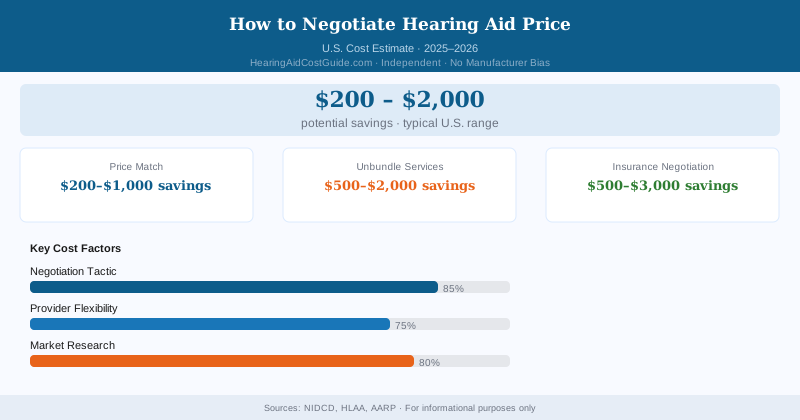
Call three different audiology practices and ask for a price on a specific model: “How much would you charge for a pair of Phonak Audéo Lumity 90s with fitting and follow-up?” Write them down. You’ll often see a $500–$2,000 spread for identical devices.
Then use it: “I’ve received a quote for [same device] at $X from another practice. Can you match that?” This isn’t rude — it’s how most markets work.
2. Ask About Unbundled Pricing
Most practices default to bundled pricing — device plus all follow-up services in one number. But many practices will also quote unbundled: the device cost separately from the service package.
Ask: “Do you offer unbundled pricing? Can you separate the device from the fitting and follow-up fees?”
Unbundled device prices typically run 20–30% lower than the bundled total. If you’re someone who tends to need fewer follow-up visits or wants to manage your own apps and adjustments, unbundled represents real savings.
3. Request the Prior Year’s Model
Hearing aid manufacturers release new models every 1–2 years. When the shiny new version arrives, practices often still have previous-generation inventory — and they’ll discount it. Ask: “Do you have the [prior model year] in stock? What’s your price?”
Previous-generation premium hearing aids are functionally excellent. The new version might have one extra Bluetooth feature or a slightly faster processor, but the core hearing performance is very similar. Savings: $500–$1,500 per pair.
“Thank you for the recommendation. I’ve been doing some research, and I notice that [same device] is available at Costco for $1,799/pair including fitting and follow-up. I prefer to work with a doctoral audiologist and would like to stay here. Is there any flexibility in your pricing to help bridge that gap? I’m ready to proceed if we can get closer to that level.”
This script:
- Shows you’ve done your homework
- References a legitimate competitive price (Costco is real competition, not bluffing)
- Affirms your preference for their services
- Creates urgency (ready to proceed)
- Doesn’t make an unreasonable demand
4. Ask About Package Deals
Some practices discount the device price when you add accessories or warranties at the same time. It’s worth asking: “If I add the TV streamer and a loss/damage plan today, can you bring the device price down at all?” The math sometimes works for both sides.
5. Use Your Insurance Benefit as Leverage
If you have a Medicare Advantage or employer hearing benefit, mention it directly: “My insurance covers $1,000 through TruHearing. I’m choosing to use your practice instead. Can you match TruHearing pricing?”
Some practices say yes. Keeping a patient in-house at TruHearing-equivalent pricing beats losing them to the network entirely.
6. Costco Is Your Best Leverage
The single most effective negotiating tool is the Costco price — and it’s not a bluff. Costco’s Kirkland Signature 10.0 runs $1,499/pair and is legitimately competitive with prescription-grade hearing aids. Mentioning Costco signals that you know the market. Private practices know they compete with Costco every day.
Some will drop their price by $500–$1,500/pair to keep a patient who would otherwise go there.
What You Probably Can’t Negotiate
- Audiogram fees: Professional service with a fixed fee structure; less negotiable
- Fitting and follow-up services: These take real time; deep discounts here may mean less comprehensive care
- OTC hearing aid pricing: Amazon and Best Buy have fixed prices — no negotiation available
What Practices Will Sometimes Do Instead of a Price Reduction
If the device price won’t budge, push for equivalent value in services or accessories:
- Extended service period (3 years instead of 2 of included follow-ups)
- Loss and damage coverage included at no extra charge
- Free accessories: TV streamer, remote mic, cleaning kit
- Extra battery supply for the year
These additions cost the practice less than a straight discount and may represent real value to you.
Avoid negotiating in a way that damages the clinical relationship. Your audiologist’s programming skill and follow-up quality directly affect how well your hearing aids work. The goal is a fair price — not the lowest possible price at the cost of good care. If a practice doesn’t budge at all, your recourse is to go elsewhere — not to become adversarial.
Timing Matters
End of month or quarter: Practices with monthly targets sometimes have more flexibility when they’re closing the books. A late-month conversation can go differently than one at the beginning.
Slow seasons: January and August tend to be quieter for hearing aid sales. Practices may be more open to negotiation when the waiting room isn’t full.
Just before a new model release: When manufacturers announce an upcoming product, ask about the current model at a discount before it becomes “last year’s model” by default.
The Simplest Move: Costco
For most adults without complex hearing needs, the simplest way to a competitive price requires no negotiation at all. Costco’s $1,499–$2,199/pair prices are non-negotiable — but they’re also genuinely the lowest available for professionally dispensed prescription hearing aids. If the negotiation conversation sounds exhausting, that’s a real option.