Here’s the number that should get more attention: 17% of American teenagers already have measurable noise-induced hearing loss. Not retired construction workers — teenagers. The NIDCD estimates 26 million Americans between ages 20 and 69 have hearing damage caused at least partly by noise, and the number keeps growing.
What makes this especially maddening: noise-induced hearing loss is one of the most completely preventable disabilities in the United States. You can’t feel it happening. Your cochlea sends no distress signal while hair cells are being permanently destroyed. The only feedback you get is a bit of ringing that usually fades by morning — and you assume everything’s fine.
It isn’t. But cheap, effective protection exists. Here’s how damage happens and what it actually costs to prevent it versus treat it.
How Noise Actually Damages Hearing
When sound enters the cochlea, it creates waves in the cochlear fluid that cause the basilar membrane to vibrate. The stereocilia — the hair-like projections on top of the hair cells — bend in response. In moderate sound, they spring back. Under loud sound:
Acoustic trauma (very loud, brief): A single intense noise (gunshot, explosion) can mechanically tear stereocilia off the hair cells. This causes immediate, often permanent hearing loss in the frequencies corresponding to that part of the cochlea.
Noise-induced damage (cumulative): Prolonged or repeated loud noise causes metabolic stress in hair cells. The cells consume oxygen rapidly trying to sustain their response, produce metabolic waste products, and eventually die. This is the mechanism behind gradual noise-induced hearing loss from occupational or recreational exposure over years.
Either way, the result is the same: dead hair cells that don’t regenerate.
The Decibel Guide: Where Safe Ends and Dangerous Begins
Sound intensity doubles with every 10 dB increase — it’s a logarithmic scale. NIOSH (the National Institute for Occupational Safety and Health) and OSHA publish occupational exposure limits; NIOSH limits are more protective.
| Sound Level (dB) | Example | NIOSH Safe Exposure Limit | Risk |
|---|---|---|---|
| 60 dB | Normal conversation | No limit | Safe |
| 70 dB | Dishwasher, moderate traffic | No limit | Safe |
| 80 dB | Blender, alarm clock | No limit | Minimal |
| 85 dB | Heavy city traffic, lawn mower | 8 hours | Caution threshold |
| 88 dB | Loud lawn mower | 4 hours | NIOSH limit halves every 3 dB |
| 91 dB | Motorcycle, power tools | 2 hours | Significant risk |
| 94 dB | Hair dryer (loud setting) | 1 hour | High risk |
| 100 dB | Subway train (platform level) | 15 minutes | Serious risk |
| 105 dB | Live music club, earbuds at max | 5 minutes | Very serious risk |
| 110 dB | Rock concert, chainsaw | 2 minutes | Rapid damage |
| 115 dB | Ambulance siren (nearby) | 30 seconds | Very rapid damage |
| 120 dB | Jackhammer at 3 feet, nightclub | Near-immediate | Dangerous |
| 130+ dB | Jet engine (nearby) | Seconds | Immediate damage |
| 140+ dB | Gunshot, firecracker | Instantaneous | Acute trauma |
Note that the NIOSH 3 dB exchange rate means safe exposure time halves with every 3 dB increase. At 88 dB you get 4 hours; at 91 dB, 2 hours; at 94 dB, 1 hour. At 110 dB, you’re in damage territory within 2 minutes.
The Most Common Causes
Occupational exposure remains the leading cause of noise-induced hearing loss in adults. The Bureau of Labor Statistics estimates approximately 17,700 new cases of work-related hearing loss annually — a significant undercount given how underreported occupational hearing loss is. High-risk occupations:
- Construction workers
- Military service members (firearms, jets, explosions — tinnitus and hearing loss are the #1 and #2 VA disability claims)
- Manufacturing and factory workers
- Musicians and sound technicians
- Farmers (tractors, grain dryers)
- Airline ground crew
- Firefighters and police officers
- Dentists (high-speed drills consistently measure 90+ dB)
Recreational exposure — increasingly recognized as a significant contributor, especially for younger people:
- Concerts and clubs: front-row concert levels routinely exceed 110 dB
- Personal audio devices: modern headphones and earbuds can reach 105–110 dB at max volume
- Power tools: table saws (~100 dB), leaf blowers (~95 dB)
- Motorcycles: ~95–100 dB at highway speeds, compounded by hours of continuous exposure
- Hunting and shooting sports: firearm reports at 140–165 dB — among the most dangerous recreational exposures
Temporary vs. Permanent Threshold Shift
After loud noise exposure, two things might happen:
Temporary threshold shift (TTS): Hearing becomes muffled, tinnitus appears, then improves over 16–48 hours. The hair cells were stressed but survived. Most people interpret this as: “My hearing came back — I’m fine.”
They’re not fine. Research shows that repeated temporary shifts cause cumulative permanent damage. The cells that “recover” are less resilient each time. The absence of permanent damage today doesn’t mean the exposure was safe; it means you got away with it this once.
Permanent threshold shift (PTS): Hearing loss that doesn’t recover. It typically hits the 4,000 Hz frequency first — producing the distinctive “4 kHz notch” on audiograms of noise-exposed people. That notch may not be obvious at first. But as damage spreads to adjacent frequencies over years, speech understanding starts to go — and by then, the damage is done.
Noise-induced hearing loss has no warning signs — you don’t feel it happening. By the time you notice that conversations are harder to follow, or that you can’t hear your grandchildren clearly, the damage is already permanent. The only intervention that matters is protection before the exposure, not treatment afterward.
Protection Options and What They Cost
The good news: hearing protection is cheap, effective, and available anywhere. There’s genuinely no reason excessive noise exposure should cost you hearing.
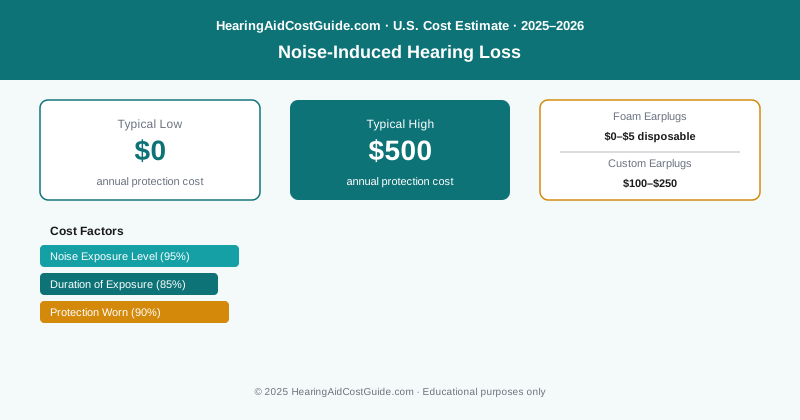
Foam earplugs — the ubiquitous orange rolled plugs. When inserted correctly (rolled thin, inserted deep, held until they expand), they provide 25–33 dB of noise reduction. They’re the most effective protection per dollar available.
- Standard disposable foam plugs: $0.25–$2.00 each
- Properly inserted, they’re effective enough for most non-extreme occupational and recreational exposures
- The catch: most people insert them incorrectly (not deep enough), getting far less than the rated attenuation
Earmuffs — cup over the entire outer ear. Provide 25–30 dB of noise reduction. Easier to use correctly than earplugs (no insertion required). Good for shooting ranges, power tools, lawn equipment.
- Basic earmuffs: $15–$50
- Electronic earmuffs (compress loud sounds while amplifying quiet sounds — excellent for situational awareness at a shooting range): $50–$300
Custom earplugs — impressions of your ear canals are taken by an audiologist and used to fabricate perfectly fitting ear plugs in silicone or acrylic. They insert easily, seal precisely, and are far more comfortable for extended wear.
- Custom solid plugs: $50–$100
- Custom musician earplugs with flat-response acoustic filters: $100–$250 (these reduce all frequencies equally — you hear the music, just quieter, without the muffled quality of foam plugs)
- Custom hearing protection for hunters and shooters: $150–$300
Electronic hearing protection for shooters — combines significant impact noise protection (for firearm reports) with amplification of ambient sounds (so you can hear range commands and conversation). A significant improvement over standard muffs for anyone who shoots regularly.
- Electronic earmuffs: $50–$200
- Custom electronic in-ear protection: $200–$500
Safe listening with headphones and earbuds: The 60/60 rule — no more than 60% of max volume, for no more than 60 minutes at a stretch — is a practical guideline. Apple, Android, and most modern devices now include hearing health features that monitor and alert to excessive cumulative exposure. Use them.
| Protection Type | Best For | Noise Reduction | Cost |
|---|---|---|---|
| Foam earplugs | General use, concerts | 25–33 dB (when inserted correctly) | $0.25–$2 each |
| Earmuffs | Lawn equipment, power tools | 25–30 dB | $15–$50 |
| Electronic earmuffs | Shooting, hunting | 22–30 dB (impact) + amplification | $50–$300 |
| Custom solid plugs | Swimming, sleep, work | 25–35 dB | $50–$100 |
| Custom musician plugs | Concerts, music practice | 9–25 dB flat response | $100–$250 |
| Custom electronic in-ear | Shooting sports | High impact protection + amplification | $200–$500 |
NIOSH Sound Level Meter App: Free Monitoring
NIOSH offers a free Sound Level Meter app for iOS (NIOSH SLM) that turns your smartphone into a calibrated sound level meter. It’s not a substitute for professional equipment, but it’s accurate enough to tell you whether the environment you’re in exceeds 85 dB and whether protection is warranted. Useful at concerts, restaurants, sporting events, and around machinery.
Older adults with existing hearing loss — already wearing hearing aids — sometimes assume they don’t need to worry about additional noise exposure because “my hearing is already bad.” This logic is backwards.
Remaining hearing function is exactly what needs protection. Every additional noise exposure can further damage the surviving hair cells that current hearing aids are compensating for. Worse hearing means worse hearing aid outcomes and potentially moving into cochlear implant candidacy territory.
If you’re already in hearing aids, using them appropriately includes wearing hearing protection in loud environments. Hearing aids don’t protect against noise damage — they only amplify and process sound. They provide no protection whatsoever against acoustic trauma.
The math here is stark. A pair of foam earplugs: under a dollar. A pair of hearing aids: $2,000–$7,000, replaced every 5–7 years. There is no scenario in which skipping the earplugs saves money. The only thing it costs you is the hearing you had.