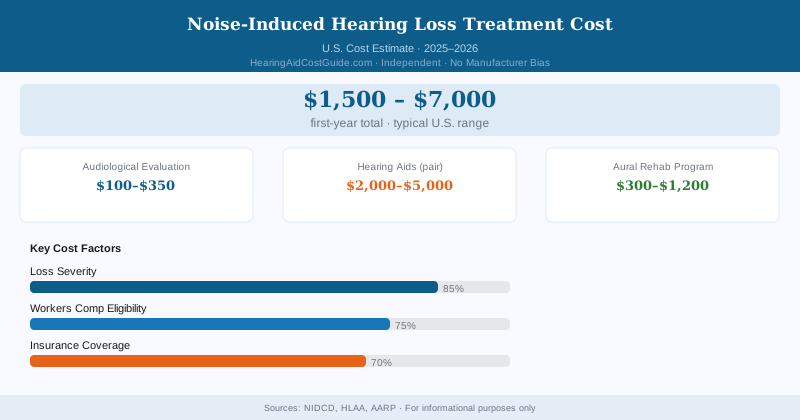
In 2010, a standard audiogram for a factory worker cost about $120. Today that same test runs $150–$350 — but here’s what hasn’t changed at all: noise-induced hearing loss (NIHL) is still permanent. There’s no surgery to fix it and no medication to reverse it. Once those hair cells in your cochlea are damaged by loud sound, they don’t grow back. What you can do is manage the loss, maximize the hearing you have left, and prevent further damage. That’s where treatment costs come in.
What “Treatment” Actually Means for NIHL
Unlike some types of hearing loss, NIHL isn’t treated with a single procedure. Treatment is a combination of:
- Audiological evaluation — to measure the extent and pattern of loss
- Hearing aids — the primary intervention for functional rehabilitation
- Hearing rehabilitation / aural rehab — training to maximize speech understanding
- Tinnitus management — NIHL frequently causes tinnitus; this adds its own cost track
- Monitoring — annual audiograms to track progression or stability
Each of these has its own cost structure. Here’s what you’re looking at.
Cost Breakdown for NIHL Treatment
| Treatment Component | Typical Cost | Frequency |
|---|---|---|
| Audiological evaluation | $100–$350 | At diagnosis and annually |
| Hearing aids (per pair, mid-range) | $2,000–$5,000 | Every 4–7 years |
| Aural rehabilitation program | $300–$1,200 | Once or as needed |
| Tinnitus evaluation | $150–$400 | At diagnosis |
| Tinnitus sound therapy device | $500–$2,500 | If needed |
| Annual audiogram (monitoring) | $100–$300 | Yearly |
| First-year total (hearing aids + eval + rehab) | $2,500–$7,000 | — |
After the first year, ongoing costs are mostly annual monitoring ($100–$300) and eventual hearing aid replacement. Five-year total costs typically run $4,000–$10,000 for someone with moderate NIHL managed with hearing aids.
Why Hearing Aids Are the Core Treatment
NIHL characteristically damages high-frequency hearing first — the 3,000–6,000 Hz range where consonant sounds live. You might hear voices clearly but miss the “s,” “f,” and “th” sounds that carry meaning. A properly programmed hearing aid amplifies those specific frequencies without over-amplifying the ranges you still hear well.
The National Institute on Deafness and Other Communication Disorders (NIDCD) estimates that approximately 17% of American adults — about 26 million people — have some degree of noise-induced hearing loss. Despite this, fewer than one in five people who could benefit from hearing aids actually uses them, largely because of cost and the stigma of wearing a device.
Prescription hearing aids fitted by an audiologist typically cost $2,000–$6,000 per pair. Over-the-counter hearing aids — now widely available under FDA rules that went into effect in 2022 — run $200–$1,500 for a pair and can be appropriate for adults with mild to moderate loss. For mild NIHL with primarily high-frequency impact, an OTC device with good high-frequency amplification is often worth trying before spending $4,000 on prescription aids.
Does Insurance Cover NIHL Treatment?
This is where it gets frustrating. The audiological evaluation and any tinnitus-specific testing may be partially covered by health insurance. The hearing aids themselves almost certainly are not — at least not through traditional Medicare or most commercial plans.
If your NIHL is occupational — caused by noise exposure at work — workers’ compensation may cover treatment costs. This applies most often to manufacturing workers, construction workers, military veterans, musicians, and anyone with documented workplace noise exposure. File a claim early; delays can complicate coverage.
The American Speech-Language-Hearing Association (ASHA) notes that only 22 states require commercial insurance plans to cover hearing aids for adults. If you’re not in one of those states, you’re likely paying out of pocket for aids regardless of your diagnosis.
If loud workplace environments caused or contributed to your hearing loss, you may be entitled to workers’ compensation coverage for:
- Audiological evaluation and diagnosis
- Hearing aid purchase and fitting
- Annual monitoring audiograms
- Tinnitus treatment
Document your work history and noise exposure carefully. An occupational medicine physician or attorney can help you establish the link between exposure and loss.
Aural Rehabilitation: Worth the Cost?
Aural rehabilitation (aural rehab) is structured training that helps your brain re-learn to process sound — especially speech — with the help of your new hearing aids. It’s offered by audiologists and speech-language pathologists.
A typical program involves 4–8 sessions at $75–$150 per session, totaling $300–$1,200. Research consistently shows that aural rehab improves speech understanding outcomes beyond what hearing aids alone achieve, especially in background noise. If you’ve had hearing loss for years before getting aids, your auditory processing has adapted to deprivation — rehab helps reverse that.
Tinnitus: The Frequent Companion to NIHL
About 90% of people with tinnitus have some degree of hearing loss, and NIHL is one of the most common causes. If your ears ring, hiss, or buzz — especially after noise exposure — that’s almost certainly tinnitus. Treatment costs add up:
- Sound therapy/masking: $0 (free apps) to $2,500 (dedicated tinnitus masker)
- Tinnitus Retraining Therapy (TRT): $1,500–$3,500 for a full program
- Cognitive behavioral therapy (CBT) for tinnitus: $800–$2,000
Many people manage tinnitus effectively with free white noise apps or low-cost sound machines ($20–$60). The expensive options are primarily for people with severe, debilitating tinnitus.
Preventing Further Loss: Still the Best Investment
A quality set of hearing protection costs $1–$50 and prevents the loss that would require thousands in treatment. Foam earplugs (NRR 33) are effective for most industrial settings. Custom-molded musician’s earplugs that attenuate evenly across frequencies run $150–$300 from an audiologist. If you’re continuing to work in noisy environments, hearing protection isn’t optional — it’s the most cost-effective treatment you can make.
No supplement, herbal remedy, or “hearing restoration” product available online has been proven to reverse noise-induced hearing loss. Save your money. If a product claims to regenerate cochlear hair cells, the science doesn’t support it. Your audiologist is the right resource, not a supplement vendor.
Bottom Line
NIHL treatment isn’t a one-time expense — it’s a long-term cost of managing a permanent condition. Your first year of treatment realistically runs $2,500–$7,000 (evaluation + hearing aids + rehab). Ongoing annual costs are $100–$300 for monitoring plus replacement aids every 4–7 years. If your loss is occupational, pursue workers’ comp before paying out of pocket. And start with an audiologist — not a supplement website.