FAQ: Everything You Want to Know About OTC Hearing Aids Before Spending Money
Wait — when did you stop needing a prescription for hearing aids?
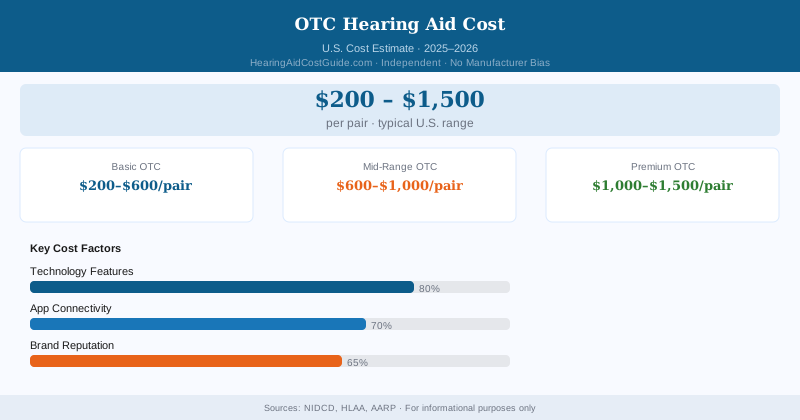
In August 2022, the FDA finalized rules making it legal to sell hearing aids directly to adults with mild-to-moderate hearing loss without a prescription, audiologist visit, or hearing test. What started as a niche policy change has turned into a real market — dozens of brands now compete across a $200–$1,600 price range.
So I can just buy one on Amazon?
Yes. Best Buy, Amazon, Walmart, and brand websites all sell OTC hearing aids without any clinical involvement. You self-fit using a smartphone app (on most models) or manual volume controls.
Is that actually safe?
For the right person — an adult with confirmed mild-to-moderate symmetrical hearing loss — yes. The FDA’s OTC category was created specifically for this population. For anyone with severe loss, asymmetrical loss, sudden hearing loss, ear pain, or a history of ear disease, OTC is not appropriate, and an audiologist visit matters.
OTC Hearing Aid Price Tiers (2025)
| Brand / Model | Price (Per Pair) | Style | Trial Period |
|---|---|---|---|
| Audien Atom | $199–$249 | ITE | 45 days |
| Sony CRE-20 | $999 | ITE | 30 days |
| Lexie B2 (powered by Bose) | $999 | RIC | 45 days |
| Sony CRE-E10 | $1,299 | ITE | 30 days |
| Jabra Enhance Select 200 | $799 | RIC | 100 days |
| Jabra Enhance Select 300 | $1,099 | RIC | 100 days |
| Jabra Enhance Select 500 | $1,499 | RIC | 100 days |
| Eargo 7 | $1,599 | ITC | 45 days |
| Lexie Lumen | $599 | RIC | 45 days |
What’s the difference between a $200 and a $1,400 OTC hearing aid?
More than you’d expect. The budget tier ($199–$400) — brands like Audien — amplifies all sounds roughly equally, has minimal noise suppression, and typically doesn’t connect to a smartphone. For someone with very mild, symmetrical high-frequency loss in a quiet environment, they can work. For a noisy restaurant or a group meeting, they struggle.
The mid-tier ($600–$1,100) adds Bluetooth streaming, app-based tuning, directional microphones, and actual noise management. The difference in real-world environments — grocery stores, family dinners, work calls — is significant.
Premium OTC ($1,100–$1,600) approaches prescription-quality performance for mild-to-moderate loss, with more sophisticated algorithms and better hardware.
What’s the actual best OTC hearing aid right now?
For most people’s first OTC purchase, the Jabra Enhance Select 200 or 300 ($799–$1,099/pair) offers the best combination of technology, support, and Jabra’s 100-day trial — the most generous in the category. If invisible canal fit matters more than app features, the Sony CRE-20 is excellent at $999.
Some “hearing amplifiers” or Personal Sound Amplification Products (PSAPs) are being marketed using hearing aid language even though they don’t meet FDA OTC hearing aid standards. Check that any device you buy carries explicit FDA OTC hearing aid classification before purchasing.
Can I try OTC hearing aids and return them?
Yes — trial periods are one of the better features of the OTC market. Jabra’s 100-day trial is the longest. Most others run 30–45 days. Use the full trial period in all your real environments (work, restaurants, phone calls, TV) before deciding. Don’t judge after a single quiet afternoon at home.
Do insurance or HSA/FSA cover OTC hearing aids?
HSA and FSA: yes, as of the 2020 CARES Act changes. Most OTC hearing aids qualify for reimbursement — save your receipt.
Insurance: generally no. Most private insurance plans don’t cover OTC devices, and original Medicare definitely doesn’t. Some Medicare Advantage plans have begun including OTC hearing aid coverage in 2025 — check your plan’s Summary of Benefits.
A Costco Jabra Enhance Pro (essentially a professional version of Jabra’s OTC line) runs $1,499–$1,799 per pair and includes professional fitting and follow-up by a licensed specialist. If you’re unsure about self-fitting, the Costco option adds meaningful value for a relatively small price premium over the best OTC devices.
Who should NOT buy OTC hearing aids?
OTC isn’t right for you if:
- Your loss is severe or profound (audiogram required to know this)
- Your two ears hear differently from each other (asymmetrical loss)
- You’ve had sudden hearing loss
- You have ear pain, drainage, or a history of ear disease
- You’ve tried OTC and found it unsatisfying without knowing why
In any of these situations, see an audiologist. A diagnostic evaluation ($150–$350) can clarify what you’re dealing with and whether OTC is even appropriate.
Bottom line — what should I actually buy?
Spend $799–$1,099 on a Jabra Enhance or Lexie B2 for solid technology and the best return policy safety net. Spend $200–$400 only if cost is the absolute constraint and your loss is very mild. Go OTC at all only if your hearing loss is mild-to-moderate — anything beyond that warrants a prescription device and a professional evaluation. The OTC category is genuinely useful, but it’s not the right tool for every job.