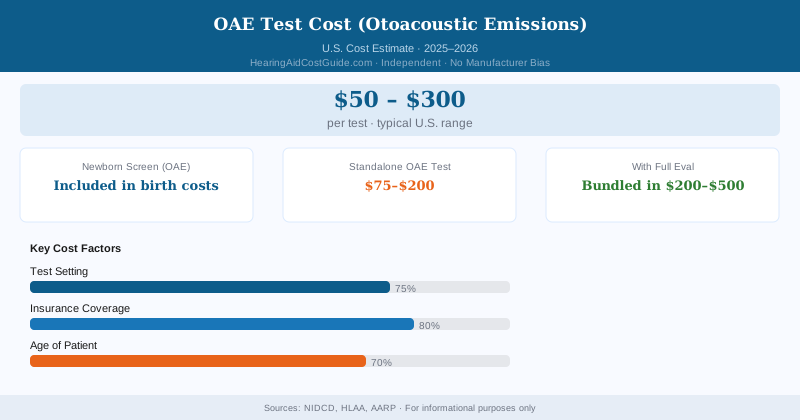
Here’s a fact that surprises most people: your inner ear makes sounds. Not audible ones, but measurable acoustic signals — tiny vibrations generated by the outer hair cells of the cochlea when they’re stimulated by sound. These are otoacoustic emissions (OAEs), and detecting them takes about five minutes and tells an audiologist quite a lot about what’s happening inside your cochlea.
OAE testing is one of the most efficient tests in audiology. No behavioral response required. No extended stimulus sets. Just a small probe in the ear canal, a brief sound, and a measurement of whether the cochlea echoes back. The CDC reports that over 98% of US newborns now receive OAE screening before leaving the hospital — and for good reason.
OAE Test Cost
| Setting | Cost | Notes |
|---|---|---|
| Newborn screening (hospital) | Included in birth hospitalization | Covered under newborn care |
| Pediatric audiology clinic | $75–$200 | Often as part of comprehensive evaluation |
| Private audiologist (standalone) | $50–$200 | Sometimes bundled with audiogram |
| Hospital audiology | $100–$250 | Often covered by insurance |
| School hearing screening program | Free | Screening-level only |
What OAE Tests Actually Measure
Healthy outer hair cells in the cochlea don’t just receive sound — they actively vibrate in response to it, and those vibrations create faint acoustic signals that travel back out through the middle ear. A sensitive microphone in the ear canal can detect them.
Normal OAEs mean the outer hair cells are intact and working. Absent or reduced OAEs mean something has damaged those hair cells — typically noise exposure, aging, or ototoxic medications.
Two types of OAE tests are used clinically:
DPOAE (Distortion Product OAE): Two simultaneous pure tones generate a measurable distortion signal if the cochlea is healthy. DPOAEs can assess individual frequencies from 500–8,000 Hz, making them the preferred tool for comprehensive cochlear mapping and ototoxicity monitoring.
TEOAE (Transient Evoked OAE): A click stimulus generates a broadband emission response. Faster and simpler than DPOAEs, TEOAEs are used primarily for newborn screening and quick cochlear health checks.
Newborn Hearing Screening
The CDC reports that 1–3 per 1,000 newborns have significant hearing loss at birth. Identifying this before six months of age — and intervening early — is critical: children identified and fit with hearing devices before six months have substantially better language outcomes than those identified later.
The U.S. newborn hearing screening infrastructure is built around this. OAE or automated ABR testing happens before hospital discharge, and parents typically don’t receive a separate bill.
If a newborn fails the initial OAE screening, the protocol moves stepwise:
- Rescreen before discharge — most “refer” results clear on retest (common cause: vernix in the ear canal)
- Outpatient OAE rescreen at 2–4 weeks — $75–$150 if needed
- Diagnostic ABR if the rescreen is also abnormal — $400–$900
OAE tests cochlear (inner ear) function only. ABR tests the entire auditory pathway from cochlea through brainstem. A child can have normal OAEs but abnormal ABR if the cochlea is healthy but the auditory nerve or brainstem pathway is dysfunctional (auditory neuropathy spectrum disorder). For newborn hearing screening, most programs use both tests for this reason.
OAE for Ototoxicity Monitoring
Certain medications destroy cochlear hair cells — a side effect called ototoxicity. The drugs with the most documented risk:
- Cisplatin/carboplatin (chemotherapy) — cochlear damage in 60–80% of patients
- Aminoglycoside antibiotics (gentamicin, tobramycin) — used for serious bacterial infections
- Loop diuretics (furosemide/Lasix) in high doses
- Quinine and antimalarial medications
This is where DPOAEs become especially valuable. Standard audiograms test speech frequencies up to 8,000 Hz. OAEs can assess extended high frequencies — 10,000–16,000 Hz — that are the first to go when ototoxic damage begins. By catching damage at these ultra-high frequencies before it reaches speech range, audiologists can sometimes alert oncologists or physicians to adjust drug dosing before the patient notices any change in hearing.
Protocol: Baseline DPOAE before treatment starts. Repeat during and after treatment. Cost per monitoring session: $150–$400.
If you’re starting cisplatin chemotherapy and your oncologist hasn’t mentioned audiology monitoring, ask for a referral. It’s standard of care at most cancer centers.
OAE and the Audiogram Together
The two tests answer different questions, and their combination is what gives audiologists the full picture:
| OAE | Audiogram | Interpretation |
|---|---|---|
| Present | Normal | Normal cochlear and auditory pathway function |
| Absent | Abnormal | Cochlear (sensory) hearing loss |
| Present | Abnormal | Possible neural/central hearing disorder |
| Absent | Normal | Possible early cochlear damage, conductive element, or auditory neuropathy |
The “Present OAE / Abnormal audiogram” combination is an important flag — it often means the cochlea is intact but the auditory nerve or central pathways aren’t processing signals correctly. That requires a very different clinical approach than standard sensory hearing loss.
OAE tests can be falsely absent with earwax or fluid in the ear canal, middle ear fluid, or in the presence of ambient noise. A single absent OAE result doesn’t diagnose hearing loss — it indicates that further testing (audiogram, tympanometry, ABR) is needed to understand why.
OAE for Occupational Noise Monitoring
Extended high-frequency DPOAEs — testing frequencies up to 16,000 Hz — can detect early cochlear damage from noise exposure before anything shows up on a standard audiogram. This is increasingly used in occupational health programs for workers in construction, manufacturing, and the military.
If your employer runs an OSHA hearing conservation program, OAE monitoring may already be part of your annual evaluation. If it’s not, and you work in consistently loud conditions, it’s worth requesting. Typical cost: $100–$200, often covered by employer health programs in OSHA-regulated industries.
Catching the 4K notch on a standard audiogram means damage has already accumulated. Catching high-frequency changes on DPOAE means there’s still time to change exposure habits before speech-range hearing is affected.