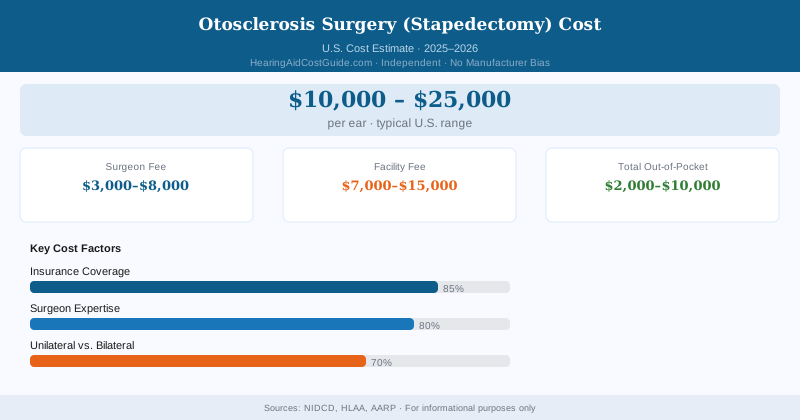
Before vs. After: The Cost of Treating Otosclerosis Two Ways
| Hearing Aids | Stapedectomy | |
|---|---|---|
| Upfront cost | $1,500–$6,000/pair | $10,000–$27,000 (before insurance) |
| Patient out-of-pocket (w/ insurance) | $1,500–$6,000 (often not covered) | $2,000–$5,000 (covered surgery) |
| Repeat costs | Every 5–7 years for new aids | Typically one-time (per ear) |
| 30-year total cost | $9,000–$36,000+ | $2,000–$5,000 (insured) |
| Hearing outcome | Amplification-dependent forever | Near-normal hearing in 90% of cases |
That contrast is why most young patients with otosclerosis choose surgery. One procedure, covered by insurance, versus decades of hearing aid costs that insurance typically won’t touch.
What Is Otosclerosis?
Otosclerosis is an abnormal remodeling of the bony labyrinth — the hard shell around the inner ear — that fixes the stapes bone in place. The stapes is the smallest bone in the human body and its job is transmitting sound vibrations from the middle ear into the inner ear. When abnormal bone growth pins it down, sound transmission fails, and progressive conductive hearing loss develops.
It typically shows up in the 20s–40s, progresses gradually, and tends to affect both ears (though often one at a time). Women are affected about twice as often as men. It runs in families, and pregnancy can accelerate progression. Fluoride supplementation (sodium fluoride) may slow progression in some patients.
Stapedectomy Cost Breakdown
| Cost Component | Estimated Cost |
|---|---|
| Otologist/neurotologist surgeon fee | $3,500–$7,000 |
| Ambulatory surgery facility fee | $4,000–$14,000 |
| Anesthesiology | $1,000–$2,500 |
| Pre-surgical audiological evaluation | $250–$400 |
| Prosthesis (piston/prosthesis device) | $500–$2,000 |
| Post-op visits (3–6 months) | $400–$900 |
| Total (before insurance) | $9,650–$26,800 |
Stapedectomy vs. Stapedotomy
Both terms get used interchangeably in casual conversation, but they’re technically distinct:
Stapedectomy: The original technique. The entire stapes is removed, and a prosthesis is placed from the incus (middle ear bone above) to the oval window opening. Excellent long-term hearing outcomes.
Stapedotomy: The current preferred approach at most surgical centers. Instead of removing the whole stapes, the surgeon drills a small fenestra (opening) in the stapes footplate and inserts a smaller piston prosthesis. Less trauma to the inner ear, lower risk of perilymph fistula, equivalent hearing outcomes.
Your surgeon will likely use stapedotomy technique. The terms are often used interchangeably in patient conversations — what matters more than the name is your surgeon’s volume and experience.
“90% success” in stapedectomy research typically means ≥90% of patients achieve hearing thresholds within 10 dB of their bone conduction threshold — essentially, hearing near what the inner ear can support.
For a typical otosclerosis patient with 45 dB conductive loss and normal sensorineural reserve (bone conduction), successful surgery should restore hearing to nearly normal levels.
The remaining ~10%: approximately 5% have minimal improvement (surgery succeeded technically but hearing didn’t improve), and ~1–2% experience worsening of hearing, including rare serious complications.
Risks of Stapedectomy
Serious complications are uncommon in high-volume surgical centers, but they’re real and worth understanding:
- Total hearing loss in the operated ear: Less than 1% — the most feared outcome and the reason surgeons operate only one ear at a time
- Perilymph fistula: Inner ear fluid leak into the middle ear space; manageable in most cases
- New or worsened tinnitus: Uncommon
- Taste disturbance (chorda tympani nerve): Temporary metallic or altered taste, fairly common immediately post-op but usually resolves within weeks to months
- Dizziness/vertigo: Very common in the first days after surgery, typically resolves within 1–2 weeks
- Facial nerve weakness: Extremely rare — under 0.1%
Because of the small but real risk of total hearing loss, surgeons address one ear at a time. The second ear (when bilateral) is operated on 6–12 months after confirming the first surgery was successful.
Hearing Aids as an Alternative
Surgery isn’t the only answer — hearing aids are a legitimate alternative for specific situations:
- Older adults who want to avoid surgical risk
- Patients with a significant sensorineural component (mixed hearing loss) where surgery only addresses the conductive portion
- Patients who simply prefer not to have surgery
- Mild otosclerosis with minimal functional impact on daily life
But the long-term cost math matters. Hearing aids run $1,500–$6,000 per pair and need replacement every 5–7 years. Over 30 years, that’s $9,000–$36,000 or more — and insurance rarely covers hearing aids. Stapedectomy, covered by insurance, typically leaves patients with $2,000–$5,000 out of pocket. For young patients with good sensorineural reserve, the financial and functional arguments for surgery are compelling.
Insurance Coverage for Stapedectomy
Stapedectomy is covered by all major insurance types — Medicare, Medicaid, private insurance, TRICARE, VA — when:
- Otosclerosis is confirmed by audiological and clinical evaluation
- Hearing loss is functionally significant
- The patient meets surgical candidacy criteria (adequate sensorineural reserve, no major contraindications)
CT temporal bone imaging to confirm surgical anatomy is typically required before authorization and is covered.
Patient responsibility: Medicare patients typically pay the Part B deductible + 20% coinsurance. Private insurance patients pay toward their out-of-pocket maximum. Most insured patients end up paying $2,000–$5,000 total.
Stapedectomy requires an experienced otologist or neurotologist. Results are directly correlated with surgeon volume — practices performing 50+ stapedectomies per year have consistently better outcomes than lower-volume surgeons. Ask your surgeon specifically: “How many stapedectomies do you perform per year?” The ideal answer is 30+.
Finding an Experienced Otosclerosis Surgeon
Academic medical centers and specialty ear/nose/throat practices at major hospital systems are your best bet for finding high-volume stapedectomy surgeons. Ask your audiologist for a referral to an otologist or neurotologist specifically — not a general ENT. The subspecialty training matters for a procedure where a millimeter of surgical precision determines whether hearing is restored or lost.