The school sent home a note. Your child didn’t pass the hearing screening, and now the form is recommending a follow-up with an audiologist. You’re not sure whether this is serious, what the follow-up actually involves, or what it will cost. Here’s what happens next — and what you’ll pay at each step.
Hearing loss affects 2–3 per 1,000 newborns in the US, according to the CDC’s Early Hearing Detection and Intervention (EHDI) program. By school age, roughly 15% of children have some degree of hearing loss in at least one ear, often from chronic ear infections or noise exposure. Early identification matters — untreated hearing loss in kids directly affects speech development, language learning, and academic performance.
Step 1: Newborn Screening (Usually Free)
Nearly all US hospitals screen newborns before discharge. The test is painless — small probes or electrodes measure the ear’s response to sound while the baby sleeps. All states require newborn hearing screening programs under EHDI guidelines.
If the hospital screen is part of the delivery, it’s typically billed as part of the delivery package and covered by insurance. Nationally, about 1 in 50 newborns who fail the initial screen end up with confirmed hearing loss after follow-up testing.
Step 2: Pediatric Audiologist Evaluation
When a school screening or pediatrician referral sends you to a pediatric audiologist, here’s the cost structure:
| Test / Service | Typical Cost | Notes |
|---|---|---|
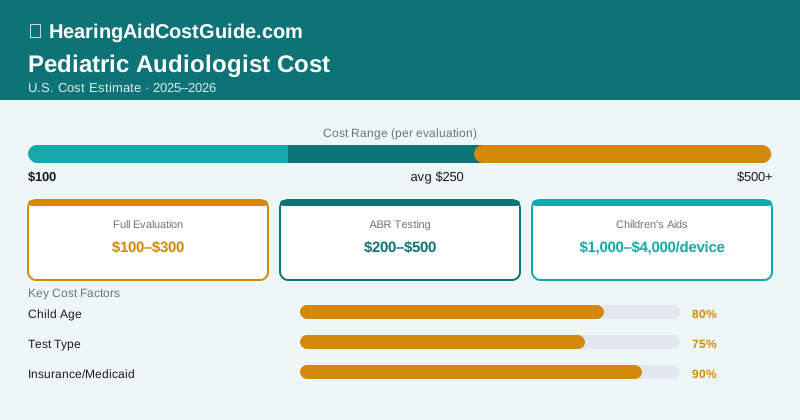
| Pediatric hearing evaluation (comprehensive) | $100–$300 | Age-appropriate behavioral tests |
| Auditory Brainstem Response (ABR) | $200–$500 | For infants or hard-to-test children |
| Otoacoustic Emissions (OAE) | $75–$150 | Quick inner ear function test |
| Tympanometry (middle ear pressure) | $50–$100 | Identifies fluid, perforation |
| Full evaluation + ABR combined | $300–$600 | Common for infants under 6 months |
Insurance covers most of these tests when ordered by a physician. Medicaid covers all diagnostic hearing evaluations for children under 21 under the EPSDT (Early Periodic Screening, Diagnostic, and Treatment) mandate — that’s federal law, not a state option. If your child has Medicaid and you’re being charged for a diagnostic hearing evaluation, push back on the billing.
CHIP (Children’s Health Insurance Program) also covers hearing evaluations, though the specifics vary by state.
Auditory Brainstem Response testing is used for infants and toddlers who can’t respond reliably to behavioral tests. Small electrodes are placed on the scalp and behind the ears. Clicking sounds play through earphones and the brain’s electrical response is recorded. The child needs to be asleep or lightly sedated — your audiologist will tell you to keep the baby awake beforehand so they’ll sleep through it. The test takes 60–90 minutes and is painless.
Children’s Hearing Aids: Cost and Coverage
Children’s hearing aids differ from adult devices in important ways: they’re more rugged, have tamper-resistant battery doors, and connect to FM systems used in school classrooms. They also need replacing more often as children grow and technology advances.
Device costs:
- Children’s hearing aids run $1,000–$4,000 per device; most children need two
- Entry and mid-tier: $1,000–$2,000 per device — appropriate for mild-to-moderate loss
- Premium with FM compatibility: $2,500–$4,000 per device
Insurance and program coverage:
Medicaid covers hearing aids for children under 21 in all 50 states — again, this is an EPSDT requirement, not discretionary. The device covered may be a “medically appropriate” model rather than the premium tier, but coverage exists. Your audiologist’s office should be experienced with Medicaid prior authorization for pediatric fittings.
Private insurance varies widely. Some states mandate hearing aid coverage for children — California, Connecticut, Illinois, and several others require coverage up to a set limit per device, typically $1,400–$3,000.
Children’s hearing aids require more maintenance than adults’ aids. The ear canal grows significantly between ages 1 and 10, which means new earmold impressions every 3–12 months. Budget $50–$150 per set for earmold replacements. Also ask specifically about the pediatric loss-and-damage policy — most manufacturers offer reduced-cost replacement for hearing aids that children break or lose, but you have to ask for it.
School Services and IDEA
Under the Individuals with Disabilities Education Act (IDEA), children with hearing loss are entitled to a free and appropriate public education. That can include:
- FM systems and soundfield systems in the classroom (provided by the school district)
- Interpreters or captioning services
- Speech-language therapy
- Specialized instruction
Schools don’t provide hearing aids themselves, but they must provide assistive technology and accommodations so the child can access education. A 504 Plan or IEP (Individualized Education Program) formalizes these accommodations — and neither requires the family to pay.
Bottom Line
A pediatric audiologist evaluation runs $100–$300; ABR testing adds $200–$500 for infants. Children’s hearing aids cost $1,000–$4,000 per device — but Medicaid covers both evaluation and devices for children under 21 as a federal mandate. If your child fails a school screening, follow up within 3 months. The EHDI benchmark is diagnosis by 3 months, intervention by 6 months for the best language outcomes. Don’t let cost concerns delay that follow-up — the coverage is there. See our audiologist visit cost guide for what adult evaluations look like in comparison.