About 2 to 3 of every 1,000 newborns in the United States are born with hearing loss in one or both ears, according to the National Institute on Deafness and Other Communication Disorders (NIDCD). Thanks to universal newborn hearing screening, most of those babies are identified within days of birth — long before any parent would suspect a problem. But diagnosis is just the start. What follows is a cascade of appointments, devices, and financial decisions that most families aren’t prepared for.
This guide walks you through exactly what children’s hearing aids cost, what government programs actually cover, and how to access services you may not know exist.
The True Cost of Pediatric Hearing Aids
Children’s hearing aids cost $1,500 to $4,000 per device, and most children with bilateral (both ears) hearing loss need two. That’s a potential out-of-pocket hit of $3,000 to $8,000 before insurance.
| Item | Typical Cost |
|---|---|
| Diagnostic ABR evaluation | $200–$500 |
| Behind-the-ear (BTE) hearing aid, economy tier | $1,500–$2,000 per aid |
| BTE hearing aid, mid-range | $2,000–$3,000 per aid |
| BTE hearing aid, premium tier | $3,000–$4,000 per aid |
| Custom earmold (each) | $50–$150 per ear |
| Earmold replacement (growing child, per year) | $100–$600 per year |
| FM/DM classroom system | $500–$1,500 |
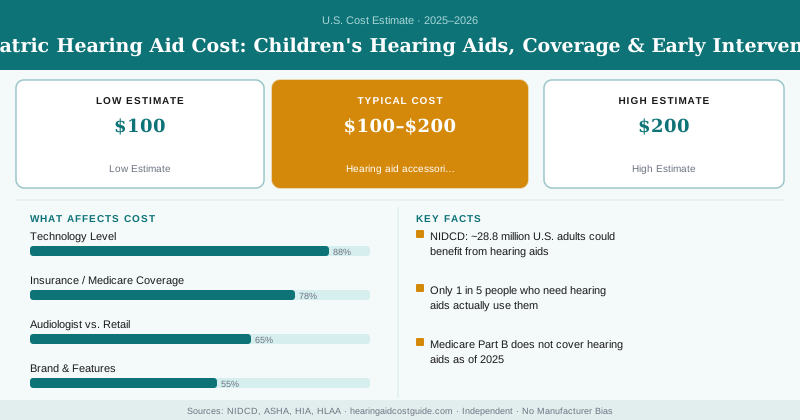
| Hearing aid accessories (batteries, drying kit) | $100–$200 per year |
The diagnostic costs hit first. After a failed newborn screen, your child will need a diagnostic auditory brainstem response (ABR) evaluation — the definitive test for infants who can’t respond to behavioral testing. This runs $200 to $500, though it’s often covered by insurance or through your state’s Early Hearing Detection and Intervention (EHDI) program.
Why Children Almost Always Wear Behind-the-Ear Aids
You might wonder why tiny, invisible-in-canal styles aren’t used for children. There’s a practical reason: kids’ ears grow fast. A custom-molded in-the-ear device would be outgrown within months. Behind-the-ear (BTE) aids sit behind the ear, connected to a custom earmold that sits in the canal — and only the earmold needs replacing as the ear grows.
BTE aids are also more durable. Children drop things, sweat, play in dirt, and handle devices roughly. The electronics are positioned behind the ear where they’re less exposed to moisture and impact. For severe-to-profound hearing loss, BTE aids can also deliver more amplification power than smaller styles.
The earmold is a recurring cost families often don’t anticipate. For an infant, ear canals grow so quickly that earmolds may need replacing every three months. Each new earmold runs $50 to $150 per ear, so a bilateral fitting costs $100 to $300 per replacement cycle.
The EHDI Program: Free Screening, Then What?
Every state runs an Early Hearing Detection and Intervention (EHDI) program under federal mandate. Newborn hearing screening itself is free in hospitals across the country. The EHDI program coordinates the follow-up diagnostic testing and connects families with early intervention services.
What EHDI doesn’t cover is the hearing aids themselves. That’s where Medicaid, insurance, or financial assistance programs come in.
- Request a referral to a pediatric audiologist — not a general audiologist. Children’s hearing loss requires specialized fitting expertise.
- Contact your state Medicaid office immediately to ask about EPSDT hearing aid benefits, even if you don’t think you qualify income-wise — thresholds vary by state.
- Call your state’s EHDI coordinator (find them at NCHAM.org) — they can connect you with local resources.
- Ask your audiologist about manufacturer loaner programs before you pay full price.
Medicaid Coverage: The EPSDT Mandate
Here’s the most important thing to know if your child has hearing loss: Medicaid must cover hearing aids for children under 21 in virtually every state.
The legal basis is EPSDT — Early and Periodic Screening, Diagnostic, and Treatment. Under federal law, Medicaid is required to cover any medically necessary treatment for children, and hearing aids clearly qualify. Most state Medicaid programs cover the aids themselves, earmolds, batteries, and related audiology services.
CHIP (Children’s Health Insurance Program) provides similar coverage for children who don’t qualify for Medicaid but whose families can’t afford private insurance. Coverage specifics vary by state, but hearing aids are included in most CHIP programs.
If your child is covered by private insurance, check your policy carefully. Many private plans specifically exclude hearing aids, especially older employer-sponsored plans. Some states have mandates requiring private insurers to cover pediatric hearing aids — check yours.
Early Intervention: Free Therapy from Birth to Age 3
Under Part C of the Individuals with Disabilities Education Act (IDEA), every state must provide free early intervention services to children with disabilities from birth through age two. For a child with hearing loss, this means:
- Speech-language pathology
- Auditory verbal therapy or listening and spoken language services
- Family training and counseling
- Service coordination
These services are provided at no cost to the family, though some states may charge a sliding-scale fee based on income. Your child’s audiologist or EHDI coordinator can refer you to your state’s early intervention program — it typically goes by a name like “First Steps” or “Early On.”
Early intervention matters enormously. Research consistently shows that children identified and treated by 6 months of age achieve significantly better language outcomes than those identified later. The NIDCD notes that children who receive early hearing aids and intervention services by 6 months develop language skills comparable to hearing peers.
School-Based Services: Part B of IDEA (Ages 3–21)
When your child turns 3, early intervention transitions to school-based services under Part B of IDEA. Your child is entitled to a free appropriate public education (FAPE) in the least restrictive environment. This includes:
- Ongoing audiology services
- Speech-language therapy through an Individualized Education Program (IEP)
- FM/DM assistive listening systems in the classroom
The school district doesn’t supply your child’s personal hearing aids — those remain a family responsibility. But the district is required to maintain and repair any FM system or other assistive device it provides. FM systems ($500–$1,500) allow the teacher’s voice to transmit directly to the child’s hearing aid via a wireless microphone — they dramatically improve signal-to-noise ratio in noisy classrooms.
Don’t assume your child’s school knows about FM systems or is proactively offering them. Many parents have to specifically request an FM system in the IEP meeting and cite IDEA Part B requirements. Bring your audiologist’s recommendation in writing.
Manufacturer Assistance Programs
Several major hearing aid manufacturers offer specific programs for children with limited financial resources:
- Phonak’s HearingFirst — connects families with financial assistance and audiologist networks
- Starkey Hearing Foundation — provides devices to children in need
- Oticon — pediatric scholarship and loaner programs through select clinics
- The Hearing Aid Project — refurbishes and distributes donated hearing aids
Ask your pediatric audiologist what programs they work with. Many practices have standing relationships with manufacturer assistance programs and can apply on your behalf.
Total First-Year Cost: A Realistic Picture
For a family paying out of pocket with no coverage, the first year with a bilaterally-fitted child can cost $6,000 to $10,000 — including diagnostic evaluations, two hearing aids, initial earmolds, follow-up fittings, and accessories. With Medicaid coverage, that same year often costs little to nothing. With private insurance that excludes hearing aids, you’re likely somewhere in between.
The ongoing costs — earmolds, batteries, repairs, annual evaluations — run $500 to $1,500 per year after that first device purchase.
Getting connected with your state’s EHDI program, checking Medicaid eligibility regardless of income assumptions, and finding a pediatric audiologist who knows the local funding landscape are the most valuable steps you can take after diagnosis.
Frequently Asked Questions
Yes, in virtually every state. Under the EPSDT (Early and Periodic Screening, Diagnostic, and Treatment) mandate, Medicaid must cover medically necessary hearing aids for children under 21. Most state Medicaid programs include hearing aids, earmolds, batteries, and related services. Check your state's Medicaid hearing benefit specifically — coverage levels vary, and some states cap the dollar amount per aid.
Not directly, no. Under IDEA Part B, school districts must provide a free appropriate public education (FAPE) for children with disabilities ages 3–21, which includes audiology services and assistive devices like FM systems used in the classroom. But the school doesn't typically supply the child's personal hearing aids — that's a family responsibility, usually handled through insurance or Medicaid. Schools can and do provide classroom FM systems, and they're required to maintain devices they do provide.
For infants and toddlers, earmolds typically need replacing every 3–6 months as the ear canal grows rapidly. For school-age children, you're probably looking at new earmolds every 6–12 months. Each replacement runs $50–$150 per ear, and you'll need two for a bilateral fitting. Budget for this ongoing cost — it adds up to $100–$600 per year just in earmolds during the early years.