Picture this: you’ve just been told you need hearing aids, and your audiologist hands you a quote for $5,500. You go home, search online, and find what looks like the same brand on eBay for $180. Before you click “Buy It Now,” there’s something you need to know — something the listing doesn’t mention.
Refurbished hearing aids occupy a narrow niche between cheap OTC devices and expensive new prescription aids. Done right — certified manufacturer refurbishment with warranty — they’re a legitimate option. Done wrong — buying random used aids from a stranger online — they’re often a waste of money and potentially harmful.
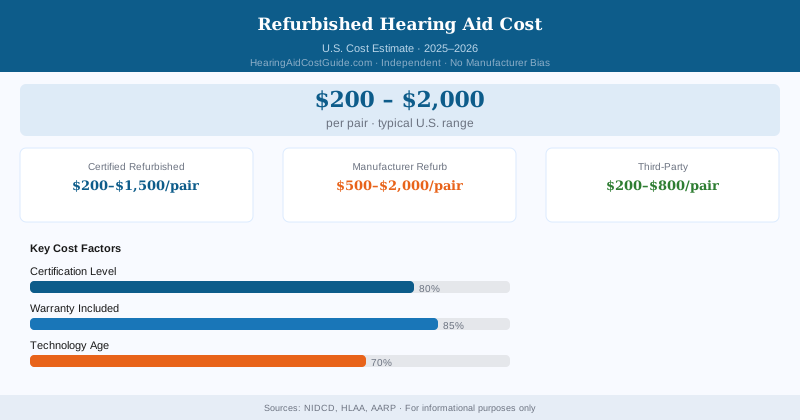
Refurbished vs. New Hearing Aid Cost
| Option | Price Range | Warranty | Fitting Support |
|---|---|---|---|
| New OTC (entry) | $199–$599/pair | 1 year | Self-fit or app |
| New OTC (premium) | $600–$1,599/pair | 1–2 years | Self-fit or app |
| New prescription | $2,000–$7,000/pair | 1–3 years | Audiologist |
| Certified refurbished (manufacturer) | $500–$1,800/pair | 6–12 months | Varies |
| Certified refurbished (third-party) | $200–$1,200/pair | 3–6 months | Varies |
| Uncertified used (eBay, Craigslist) | $50–$600/pair | None | None |
Certified Manufacturer Refurbished: The Legitimate Option
When a patient returns hearing aids during their trial period, those devices go through the manufacturer’s certified refurbishment process — not just a wipe-down:
- Full electronic diagnostic
- Cleaned and sanitized
- Replaced wear components (dome, wax filter, battery door)
- Reprogrammed to factory defaults
- Tested to original specifications
- Repackaged with a new warranty (typically 6–12 months)
Where to find manufacturer-certified refurbished:
- Some audiology practices sell returned hearing aids at 20–40% discount with partial warranty
- HA Exchange (hearingaidexchange.com) — certified pre-owned devices with audiologist matching
- Some manufacturer direct programs — call the brand directly and ask about refurbished device availability
Certified refurbished devices from the current generation ($500–$1,800 per pair) can be an excellent value. You’re getting functional, current-generation technology at significantly reduced cost.
Third-Party Certified Refurbished Programs
Several programs specialize in this space:
Audient Alliance: Not refurbished per se, but provides income-qualifying access to new hearing aids at $400–$1,700/pair through participating audiologists.
National Hearing Aid Service: Repairs and refurbishes hearing aids; some refurbished inventory available at a discount.
Local audiology practices: Many practices have a handful of returned devices each year. Ask directly: “Do you have any certified returned hearing aids available at a discount?” You might be surprised.
The eBay / Facebook Marketplace Problem
This is where things go wrong. Used hearing aids sold by individuals — not certified programs — create a cascade of problems:
- Can’t be programmed to your audiogram without the original audiologist’s software and the brand’s proprietary programming hardware
- No warranty and no recourse when something breaks
- Sanitary concerns — ear devices are medical products; used ear tips and components carry real infection risk
- Counterfeit risk — fake hearing aids are sold online as branded products more often than you’d think
Here’s the part most people don’t realize: hearing aids are programmed to one specific person’s audiogram. If you buy a used Phonak on eBay, you’d need an audiologist with Phonak Target software and the device’s serial number to reprogram it to your hearing profile — and many audiologists won’t take on that liability. The HLAA notes that this programming barrier is one of the most misunderstood aspects of the used hearing aid market.
A hearing aid bought used on eBay is essentially a paperweight until it’s reprogrammed by an audiologist to your specific audiogram. Add the cost of programming ($150–$300) to the used device price, and you’re often within range of better alternatives — a new OTC device or a Costco device with professional fitting included.
Do the full math before buying from a non-certified source.
When Refurbished Makes Sense
Good candidates for certified refurbished hearing aids:
- Budget-constrained buyers who’ve confirmed mild or moderate hearing loss
- People who want to test hearing aids before committing to full new prescription pricing
- Buyers who found the same model new elsewhere but want to save 30–40%
- People who want professional fitting but can’t afford new prescription pricing
Not appropriate for:
- Severe or profound hearing loss requiring high-power devices
- Children (hearing needs change too quickly; refurbished devices may not keep pace)
- Anyone without a current audiogram — you genuinely can’t know whether the device will work for you
If a refurbished device source can’t tell you exactly what refurbishment steps were performed, what warranty is included, and which devices are available by specific model and generation — look elsewhere. Vague “refurbishment” claims without specifics are a yellow flag for inadequate reconditioning.
Older Technology: Not Worth It Below a Certain Year
Hearing aid technology has advanced dramatically in the last 5–7 years. Devices from 2017 or earlier typically lack:
- Bluetooth streaming (most models)
- Rechargeable batteries
- AI sound processing
- Smartphone app integration
- Current noise reduction algorithms
A 2017 premium hearing aid is functionally about equivalent to a 2025 entry-level new device — at best. When buying refurbished, confirm the device generation. Aim for 2021 or newer to get meaningful capability.