School Hearing Screening Cost: What’s Covered & When to Follow Up
Your child came home with a form saying they didn’t pass their school hearing screening. Now what?
First: don’t panic. A failed school screening doesn’t mean your child has permanent hearing loss. It means they need a proper follow-up evaluation with an audiologist. Here’s what that looks like, what it costs, and what happens if the audiologist does find something.
Are School Hearing Screenings Free?
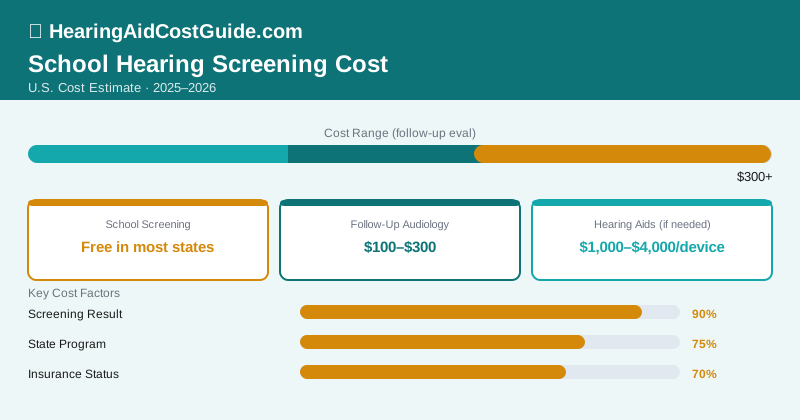
Yes — in most states. School-based hearing screenings are mandated by law in 37 states plus the District of Columbia as of 2025, according to the American Speech-Language-Hearing Association (ASHA). In states without a mandate, most districts run them anyway as part of routine health checks.
The screening itself costs parents nothing. A school nurse, health aide, or visiting audiologist runs a simple pass/fail pure-tone test. Your child listens to tones through headphones and raises a hand when they hear each one. The whole thing takes about 5 minutes.
What school screenings catch:
- Significant hearing loss at the frequencies tested (typically 500, 1,000, 2,000, and 4,000 Hz)
- Conductive hearing loss — often from fluid in the middle ear
- Unilateral hearing loss when the test is conducted per ear
What school screenings miss:
- Mild hearing loss (thresholds between 20–35 dB)
- High-frequency hearing loss above 4,000 Hz — the range critical for some consonant sounds
- Auditory processing disorders — the ears function normally, but the brain misinterprets the signal
- Fluctuating hearing loss, which is common with ear infections
That’s why a failed screening always warrants follow-up — and why passing doesn’t guarantee perfect hearing.
What Does the Follow-Up Cost?
When your child is referred, you’ll see an audiologist at a private clinic, hospital, or ENT practice. Costs depend on the child’s age and what tests are needed:
| Service | Typical Cost | Coverage Notes |
|---|---|---|
| Pediatric hearing evaluation | $100–$300 | Usually covered by insurance |
| Audiogram (pure-tone + speech testing) | $75–$200 | Usually covered by insurance |
| Tympanometry (middle ear pressure) | $50–$100 | Usually covered, often bundled |
| Otoacoustic emissions (OAE) | $75–$150 | Usually covered |
| ABR testing (infants/hard-to-test) | $200–$500 | Usually covered |
| Full diagnostic evaluation | $150–$400 | Usually covered with referral |
Insurance covers diagnostic hearing evaluations in most cases when ordered by a physician or following a school referral. Medicaid covers them in all 50 states for children under 21 — that’s a federal EPSDT requirement, not a state option. If you’re on Medicaid and being asked to pay out of pocket for a diagnostic evaluation, that’s worth disputing with the billing office.
Some pediatricians will write a referral directly based on the school’s notification letter — ask at your child’s next well visit, or call ahead. A physician referral often ensures insurance classifies the evaluation as diagnostic rather than screening, which may have different cost-sharing. If you self-refer, confirm with your insurance whether you need pre-authorization. Either way, the school screening letter serves as documentation of medical necessity.
If the Audiologist Finds Hearing Loss
Roughly 15% of school-age children have some degree of hearing loss, per the NIDCD. Most cases are mild, and many are temporary — fluid in the middle ear (otitis media with effusion) is the most common cause and often resolves on its own or with straightforward treatment.
If the loss is temporary or conductive:
- Watchful waiting (free), or
- Referral to an ENT for ear tubes if fluid is persistent — ask your doctor for the surgical cost details
If the loss is permanent:
- Hearing aids: $1,000–$4,000 per device for children’s models
- FM systems for classroom use (often provided by the school district under IDEA at no cost to the family)
School accommodations available under federal law:
- Under IDEA (Individuals with Disabilities Education Act), children with hearing loss that affects educational performance are entitled to a free and appropriate public education — including an IEP with hearing-related accommodations
- Under Section 504, children who don’t qualify for an IEP can still get a 504 Plan with classroom accommodations like preferential seating and FM system access
Neither IDEA nor Section 504 requires the family to pay for school-provided hearing technology or services.
Don’t wait too long to follow up on a failed screening. ASHA recommends completing follow-up evaluations within 3 months. Children with unidentified hearing loss are at significantly higher risk for delays in reading, language development, and academic achievement. The evaluation is almost certainly covered by your insurance — the delay has a real cost even when the dollars don’t.
What If the School Doesn’t Screen?
If your child’s school doesn’t offer screenings, or if you have concerns outside the normal schedule, request a hearing evaluation at your child’s next well-child visit with the pediatrician. Pediatricians screen hearing at routine checkups through age 5. For older children with concerns about hearing, speech, or classroom attention difficulties, ask for a referral to a pediatric audiologist.
See our pediatric audiologist cost guide for a full breakdown of what that appointment involves.
Bottom Line
School hearing screenings cost nothing — they’re part of your child’s routine health services. If your child fails one, the follow-up audiologist evaluation runs $100–$300 and is covered by most insurance and all state Medicaid programs for children under 21. A failed screening doesn’t mean serious hearing loss, but it does mean you need a complete evaluation. Follow up within 3 months, bring the school’s referral letter to the appointment, and ask specifically about classroom accommodations if any hearing loss is confirmed.