Roughly 1.3 million Americans have single-sided deafness (SSD) — one ear with normal or near-normal hearing and one ear with profound hearing loss. It’s a different problem than bilateral hearing loss, and it needs different solutions. You can’t localize sound. If someone speaks from your deaf side, it might as well be a wall between you. Background noise becomes exhausting in ways people with two working ears simply don’t notice.
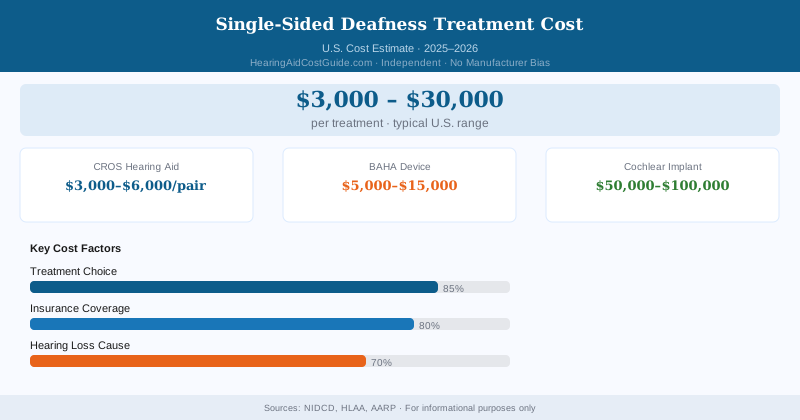
The good news: there are more treatment options than ever. The costs vary enormously — from $2,000 to over $100,000 — depending on which path you take.
Treatment Options and Costs for Single-Sided Deafness
| Treatment | Cost | Surgery Required | Hearing Ear | Deaf Ear |
|---|---|---|---|---|
| No treatment (watch) | $0 | No | Hears normally | Stays deaf |
| CROS hearing aid | $2,000–$4,500/set | No | Receives signal | Microphone picks up sound |
| BiCROS hearing aid | $2,500–$5,000/set | No | Hearing aid+CROS signal | Microphone |
| BAHA Softband (trial) | $2,500–$4,500 | No | Via bone vibration | Microphone on bad side |
| BAHA (surgical) | $10,000–$25,000 | Yes | Via bone conduction | Microphone on bad side |
| OSIA (transcutaneous BAHA) | $12,000–$28,000 | Yes | Via transcutaneous magnet | Microphone |
| Cochlear implant (SSD) | $50,000–$100,000 | Yes | Natural hearing preserved | Electrode in cochlea |
Option 1: CROS Hearing Aids (Most Common First-Line)
CROS (Contralateral Routing of Signal) is two devices working as a team:
- A microphone worn on the ear with no usable hearing (the deaf side)
- A receiver/transmitter worn on the hearing ear
Sound picked up on the deaf side gets wirelessly transmitted to the hearing ear. You hear your good side’s sounds normally, plus the signal coming from the bad side.
Cost: $2,000–$4,500 for the two-piece system. All major brands offer CROS systems — Phonak CROS, Signia CROS, Starkey CROS, Oticon CROS.
What CROS does well: People speaking from your deaf side become audible. You stop constantly rotating your head to catch conversations.
What CROS doesn’t do: It doesn’t restore the ability to localize sounds. The transmitted signal competes with the hearing ear’s natural input, and some users find that disorienting at first. It takes adaptation.
Option 2: BiCROS (If the Hearing Ear Also Has Loss)
BiCROS is the right choice when the hearing ear also has hearing loss requiring amplification. The receiving device is a full hearing aid — not just a receiver — providing amplification and the CROS signal simultaneously.
Cost: $2,500–$5,000 for the complete system.
CROS: Your “good” ear has normal or near-normal hearing. The CROS device simply routes the bad ear’s microphone to the hearing ear with no amplification.
BiCROS: Your “good” ear has hearing loss (mild-to-moderate). The receiving device is a hearing aid that both amplifies the hearing ear AND receives the signal from the bad ear.
Your audiologist will determine which based on your audiogram for the better-hearing ear.
Option 3: Bone-Anchored Hearing Aids (BAHA) for SSD
BAHA systems for SSD work by transmitting sound from the deaf side through bone conduction to the cochlea of the hearing ear — completely bypassing the non-functional ear.
Softband (non-surgical): $2,500–$4,500. An elastic headband holds the processor against the skull. This is how most patients trial bone conduction therapy before committing to surgery. FDA-cleared specifically for this purpose.
Percutaneous BAHA (abutment-based): $10,000–$25,000 total. A titanium implant in the skull lets an external processor snap on. FDA-cleared for SSD and often covered by insurance.
Transcutaneous BAHA (magnetic — Osia, Ponto): $12,000–$28,000 total. Implant sits under the skin with magnetic retention; no external abutment to maintain. Slightly reduced signal strength compared to percutaneous, but less maintenance.
Some SSD patients prefer BAHA over CROS for a straightforward reason: sound is perceived as coming from both sides, which feels more natural. Also, nothing worn on the hearing ear — it stays completely free.
Option 4: Cochlear Implant for SSD
This is the newest option — FDA cleared for SSD in 2019. Rather than routing sound to the good ear, a cochlear implant in the deaf ear attempts to restore bilateral hearing input. That’s a fundamentally different goal, and it matters.
Advantages over routing solutions: Potential to restore sound localization, reduce head shadow effect more effectively, provide genuine binaural input to the brain.
Disadvantages: Major surgery, cost in the $50,000–$100,000 range before insurance, and a rehabilitation commitment. Outcomes in SSD are promising but less uniformly excellent than for bilateral profound loss.
According to the NIDCD, cochlear implants for SSD are an active area of research, with emerging evidence that earlier implantation produces better outcomes. Best candidates are adults with post-lingual SSD — meaning they lost hearing after developing normal hearing and speech — with shorter duration of deafness in the affected ear.
Insurance Coverage for SSD Treatments
CROS/BiCROS: Not covered by original Medicare; covered by some Medicare Advantage plans (treated as hearing aids). Private insurance coverage varies widely.
BAHA: Covered by Medicare (as a prosthetic device), Medicaid, and most private insurance when medically indicated for SSD or conductive hearing loss. Pre-authorization is typically required, and worth pursuing — the savings are substantial.
Cochlear implant for SSD: Covered by Medicare and most private insurance for qualifying candidates since the 2019 FDA clearance.
Just using the good ear without any device is common — but it comes with real functional costs: increased listening fatigue, difficulty using the phone on the deaf side, and genuine safety concerns around sound localization (traffic, for example). If SSD is affecting your work, social life, or safety, a trial of CROS hearing aids or a BAHA softband is worth exploring before writing off treatment entirely.