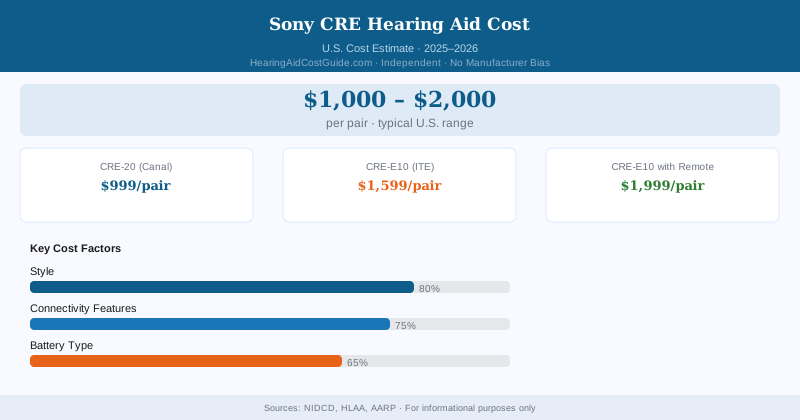
When Sony launched the CRE line in 2022, a lot of people who’d been skeptical of OTC hearing aids suddenly took notice. That’s not a knock on Eargo or Jabra — it’s just that “Sony” carries a different kind of weight for consumers who grew up with Walkmen and PlayStation. The brand legitimized an entire product category.
The question is whether the devices are actually good, or whether you’re paying for the logo.
Sony CRE Model Comparison and Pricing
| Model | Price | Style | Key Differentiator |
|---|---|---|---|
| Sony CRE-20 | $799–$999 | ITE (in-the-ear) | Invisible; basic self-fitting |
| Sony CRE-E10 | $999–$1,299 | ITE (in-the-ear) | More advanced processing; audiologist access |
Both models are available at Best Buy, Amazon, and sony.com. Return policy: 30 days from purchase.
Sony CRE-20 ($799–$999): The Invisible Entry
Here’s what you’re getting with the CRE-20:
- In-the-ear canal design — less visible than the RIC-style aids from Jabra or Lexie
- Self-fitting via the Sony Hearing Control app (iOS and Android)
- App-based 5-question hearing profile setup (not a formal audiogram, just a starting point)
- Rechargeable in a pocket-sized case
- Made for iPhone streaming via the Sony Hearing Control app
- IP58 water resistance — submersion-rated, which is impressive for a hearing aid
- 26+ hours of battery life per charge
- Feedback cancellation and basic noise reduction
Honest assessment: The CRE-20 is an excellent pick for people who prioritize discretion and water resistance above everything else. The self-fitting process is simple and works well for straightforward mild high-frequency loss. Noise performance in crowded environments is decent — but behind the Jabra Enhance 300 at a comparable price. If you’re regularly in loud restaurants, the Jabra is probably the better call.
Sony CRE-E10 ($999–$1,299): With Remote Audiologist Access
The E10 steps up with:
- WS Technology (Wound Sound) sound processing, adapted from Sony’s professional audio heritage
- More advanced frequency adjustment options in the app
- Remote audiologist setup: Sony partners with hearing care providers who can remotely guide E10 fitting
- Wider dynamic processing range for moderate-to-moderate-severe loss
- Slightly larger housing for more processing capability
- Same IP58 waterproofing and rechargeable charging case
The E10’s biggest differentiator is that remote audiologist option. Sony connects E10 buyers with hearing care professionals for a guided setup session. It’s not a full clinical fitting — don’t confuse it for one — but it’s meaningfully more supported than pure self-fitting. For a first-time hearing aid user, that hand-holding matters.
Sony rates the CRE series at IP58 — the “8” means the device is rated for continuous submersion beyond 1 meter depth. Most hearing aids are rated IP67 or IP68 (dust-tight plus water-resistant up to 1 meter). Sony’s rating puts the CRE among the most water-resistant hearing aids available at any price.
This is genuinely meaningful for heavy sweaters, people in humid climates, or anyone who wants aids that can handle light water activities. Still avoid prolonged submersion — swimming and diving are a different category.
Sony vs. Eargo: Both Invisible, Different Philosophy
The most direct OTC comparison: both Sony CRE and Eargo target buyers who want invisible in-canal hearing aids. Here’s how they stack up:
Sony CRE-E10 ($1,299) vs. Eargo 7 ($1,599):
- Sony: Lower price, IP58 rating, Sony brand name, Made for iPhone streaming
- Eargo: Floating bud comfort design, more natural feel in the canal, optional audiologist telehealth
- Sony has the edge on price and water resistance; Eargo has the edge on comfort and ongoing support access
Sony CRE-20 ($999) vs. Eargo 6 ($1,299):
- Sony: Invisible, rechargeable, Sony app, $300 less expensive
- Eargo: More natural canal feel, larger support community
- Sony offers better value if price is your primary consideration
Sony’s Self-Fitting Hearing Test
The Sony app includes a self-administered hearing check that creates a basic hearing profile. It uses your phone’s speaker or earbuds to assess hearing at several key frequencies. Audiologists are consistent on this point: app-based hearing checks are not equivalent to a calibrated audiogram. They’re useful for rough orientation but shouldn’t replace professional testing, especially if you’re uncertain about the degree of your hearing loss.
The NIDCD estimates that about 28.8 million U.S. adults could benefit from hearing aids — and many don’t even know how significant their loss is. If you’ve been resisting an audiogram, Costco offers free hearing tests without an appointment. It’s worth doing before you commit to any OTC device.
Where to Find the Best Price on Sony CRE
- Sony.com: Direct purchase, 30-day return, sometimes promotional pricing
- Best Buy: In-store demo available; 15-day return for hearing aids (shorter than Sony direct)
- Amazon: 30-day return; check for deals on prior models
- CVS and Walgreens: Carry select models; standard pharmacy return policies
Sony hearing aids are self-fitting products — they don’t come with any professional audiological fitting. If you’re new to hearing aids and have moderate hearing loss, consider whether the professional fitting experience at Costco (for $200–$700 more) would serve you better. First-time hearing aid users benefit significantly from professional guidance in those first 30–60 days of wear. There’s a learning curve, and having someone to call makes a real difference.