Three minutes. That’s how long tympanometry takes. And in those three minutes, a tympanometer can tell your audiologist whether there’s fluid behind your eardrum, whether your eustachian tube is functioning, whether there’s an eardrum perforation — things that a visual inspection alone often can’t confirm.
If you’re looking at it as a standalone test or you’re trying to figure out what you’ll owe, here’s the breakdown.
Tympanometry Cost
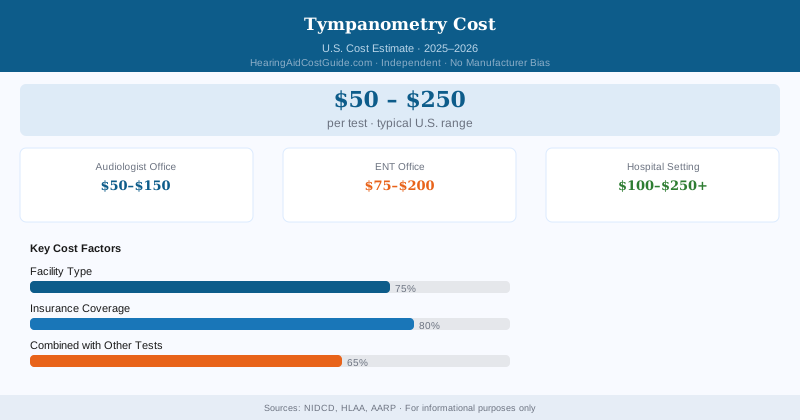
| Setting | Standalone Cost | With Full Audiogram |
|---|---|---|
| Private audiologist | $75–$150 | Usually included |
| Hospital audiology | $100–$200 | Usually included |
| ENT office | $75–$150 | Usually included |
| Pediatrician (limited immittance) | $30–$75 | Part of office visit |
| Urgent care clinic | $50–$100 | Part of visit |
In most settings, tympanometry is bundled into the cost of a comprehensive audiological evaluation — you’re not billed separately for it. Standalone billing becomes relevant when you’re getting a single test, not a full hearing workup.
What Tympanometry Actually Measures
A tympanometer places a soft rubber probe tip in the ear canal, then varies air pressure from slightly positive to slightly negative while playing a probe tone. The device measures how much sound is absorbed versus reflected at each pressure level.
The result is a tympanogram curve — and the shape of that curve tells the story:
Type A (normal): Peak at 0 daPa, normal compliance. Healthy middle ear and eardrum. Nothing wrong here.
Type B (flat): No peak — either fluid in the middle ear (otitis media with effusion) or eardrum perforation. The two are distinguished by measuring ear canal volume: a large volume suggests perforation; normal volume suggests fluid.
Type C (negative pressure peak): Peak shifted toward negative pressure — eustachian tube dysfunction. Common in early ear infections or allergy-related congestion.
Type As (shallow): Low compliance suggesting otosclerosis or a stiffened middle ear system.
Type Ad (deep/hypercompliant): Excessively mobile eardrum suggesting ossicular discontinuity or a thin, scarred eardrum.
Tympanometry assesses middle ear function — the eardrum and the air-filled space behind it. It tells you nothing about:
- Inner ear (cochlear) function
- Hearing sensitivity or thresholds
- Whether you need hearing aids
A normal tympanogram with poor pure-tone thresholds means the hearing loss is in the inner ear or auditory nerve — not the middle ear. Tympanometry and audiometry together give the complete picture that either test alone can’t provide.
Acoustic Reflex Testing: The Test That Often Tags Along
Most tympanometers also measure the acoustic stapedial reflex — the involuntary contraction of the stapedius muscle when a loud sound occurs. This reflex tests several things at once:
- The integrity of the facial nerve and brainstem auditory pathways
- Whether hearing loss is cochlear (inner ear) vs. retrocochlear (nerve or brain)
- Early signs of eighth nerve tumors like acoustic neuromas
- Certain types of middle ear disease
Acoustic reflex testing is typically included in the same session as tympanometry, billed together under CPT 92570 (screening immittance) or 92567 (tympanometry alone).
When Tympanometry Is Ordered
Ear infection evaluation: Distinguishes infected middle ear fluid from a clear middle ear cavity. This matters for treatment decisions — fluid without infection doesn’t need antibiotics, but a visual inspection alone often can’t tell the difference.
After tube surgery (myringotomy): Confirms tubes are open and functional.
Hearing aid fitting: Ensures there’s no active middle ear pathology before fitting hearing aids. You don’t want to amplify sound into an ear with untreated fluid.
Children’s hearing screenings: Often combined with OAE testing for a quick, behavioral-free assessment that doesn’t require a child to cooperate.
Pre-surgical evaluation: Before stapedectomy, tympanoplasty, or other middle ear procedures.
Eustachian tube dysfunction monitoring: Serial tympanograms track whether negative pressure resolves on its own over time.
Insurance Coverage for Tympanometry
Tympanometry is billed under CPT codes 92567 (standalone) or 92570 (immittance screening including reflexes). When performed as part of a diagnostic hearing evaluation, it’s typically covered at your specialist or diagnostic test copay rate.
In a pediatrician’s office for ear infection evaluation, it’s billed as part of the office visit — you pay the visit copay, not a separate test fee.
Home ear pressure devices and online “hearing tests” cannot replicate what tympanometry measures. If your child has had repeated ear infections or your ENT mentions middle ear fluid, insist on tympanometry — not just visual inspection — before making decisions about ear tubes. A 2021 study in Pediatrics found that clinical inspection alone misses middle ear fluid in a significant proportion of cases compared to tympanometry-confirmed assessment. The test takes three minutes and changes what you know.
A Special Note on Infants
Standard 226 Hz tympanometry isn’t accurate for infants under 4–6 months. Their ear canal walls are too compliant, which throws off the measurement. Infants require 1000 Hz (high-frequency) tympanometry — available at pediatric audiology centers and children’s hospitals. The cost is similar ($75–$175) but requires specialized equipment that’s not available at every audiology practice. If your infant needs this test, ask specifically whether the practice has high-frequency tympanometry before making the appointment.